“Like living stones, let yourselves be built into a spiritual house” —1 Peter 2:5a
I am at the Lambeth Conference of Bishops of the Anglican Communion with more than 650 bishops and more than 460 spouses from 165 countries. Our time together includes a deep dive into the First Letter of Peter led by the Archbishop of Canterbury, Justin Welby. This week Bishop Hosam Rafa Naoum, the Bishop of Jerusalem and the Middle East, who I met at his church in 2018 before either of us were elected as bishops, told me then and repeated again to a gathering this week that people go to the Holy Land to see the stones, but need to meet the living stones, the Christians of the Holy Land. Now here at Canterbury Cathedral, an ancient site of pilgrimage, I have enjoyed this historic place, but am being transformed by the living stones, the bishops and spouses from around the world.
I am in a small group Bible Study like no other as the Archbishop of Canterbury, who as an evangelical places a very high priority for scripture, opens up a passage for us. Then I gather with a group facilitated by a bishop from Kenya and meet with bishops from Northern India, South Sudan, Zimbabwe, and England. You get a passage to consider and soon you are hearing about a group of people faced with: how can we forgive the people who killed our families as we think God is calling us to do? Or how do I navigate my role as President of the Council of Churches with a Dictator who does not want to hear the truth, but my role is to speak it? There are so many more transformative conversations I have enjoyed in my time here. Like Sunday evening when I had a long talk with a 21-year old man from Sri Lanka who is a cradle member of our Church of South India, and learned of the ways his faith has been tested and yet he hears the Holy Spirit calling him to reach those hurt by the church who struggle with the same questions he encountered.
I am finding this time so humbling. The problems we face in Central and South Georgia are put into perspective by dedicated followers of Jesus who love Word and Sacrament as we do and face daily challenges we can not imagine. This is the 15th Lambeth Conference since the first in 1867. While the provinces of the Anglican Communion, such as our Episcopal Church, are independent, we are also deeply interdependent and while this conference has no authority over us, the moral authority over time makes a difference.
I have so enjoyed seeing people around our church, like Bishop Lloyd Allen of Honduras who is part of the Episcopal Church. I enjoyed serving with him on Executive Council and we both have daughters in Vet School. And then there is Bishop Mark Strange the Primus of Scotland who was in my Zoom small group in the lead up to this conference and who took part some in our pilgrimage to Scotland before Lambeth. I have also been amazed by the providence of finding myself in line for the procession on Sunday alongside a bishop to whom I introduced myself. I learned he is an assisting bishop in Kibondo, Tanzania, where I served as an intern while in seminary in 1998. We have never met and yet we know so many of the same people! What a delight.
I am here because you elected me as your bishop and I represent you here in a worldwide gathering. I remember Bishop Harry Shipps talking glowingly of meeting colleagues from around the world and coming home to share his joy in being a member of the Anglican Communion. I remember Bishop Henry and Jan Louttit being here in 2008 for the last Lambeth Conference on our behalf. (The Lambeth Conference was not held during Bishop Scott Benhase’s episcopacy).
Know that you are connected to millions of followers of Jesus around the globe who get what it is to be Prayer Book people. They face hardships we don’t have to endure and are supported by the same Jesus we know and love. This is such a comfort, a gift, and a sign of grace.
As the Bishops of the Anglican Communion meet together for the first time since 2008, Bishop Frank and Victoria Logue are representing the Diocese of Georgia at the historic meeting. First convened by the Archbishop of Canterbury in 1867, these conferences are an essential part of establishing and maintaining connections with Anglicans around the world. With the theme of ‘God’s Church for God’s World – walking, listening and witnessing together,’ the conference will explore what it means for the Anglican Communion to be responsive to the needs of a 21st Century world.
The conference takes place across venues at the University of Kent, Canterbury Cathedral, and Lambeth Palace from July 26 through August 8. The more than 650 bishops and 460 spouses represent dioceses from around 165 countries of the Anglican Communion – one of the largest Christian communities in the world.
Victoria is on the leadership team for the “House of Spouse” as the spouses of the House of Bishops are known. She will take part in a variety of events at Lambeth that will include any of the spouses of the Episcopal Church who will be present for the conference as well as spouses from around the Communion. The spouse gatherings are an important part of the meeting.
Bishops of Georgia have made the trip since our second bishop, the Rt. Rev. John W. Beckwith (1831-1890) attended two Lambeth Conferences. Bishop Logue began his preparation last August when he started meeting online monthly with a group of 15 bishops from northern India to the Yukon, including the primates of the churches of Scotland and Canada. This week, that group will meet in person for a Bible Study and then a retreat within Canterbury Cathedral to begin the meeting.
The announced goal of the conference is to resource, inspire, and encourage Bishops in their local ministries; supporting their pastoral and leadership roles in church life and mission as we all follow Jesus. In an unexpected move, the Archbishop of Canterbury sent out a 58-page document to affirm as a body. The text is problematic as it asks for clear stands together where there are deeply held differences. Most notably, it initially asked those in attendance to reaffirm Lambeth resolution I.10, from 1998, which is against extending all of the sacraments to all baptized Christians. The concerns many bishops raised, including Bishop Logue, led to a revision, which itself may be the subject of further debate. This late change is shifting the character of the meeting even as bishops are checking in on site for the conference. Please hold the Logues in prayer as they worship and discern alongside their colleagues from around the world a faithful way to continue to walk together given these differences, while honoring the dignity of all God’s children.
+Frank The Rt. Rev. Frank S. Logue, Bishop of Georgia
This week, Bishop Frank and Victoria Logue travel to the Diocese of Aberdeen and Orkney in Scotland as part of a journey to further renew an historic connection. This trip is thanks to his ordination and consecration as bishop being significantly downsized to prevent spreading COVID-19.
In the spring of 2020, Presiding Bishop Michael Curry saw how the pandemic led to history was repeating itself when planning was underway to consecrate a handful of bishops with only the minimal people present as required by canons. He was reminded of the Scottish Episcopal Church’s cathedral in Aberdeen where a small gathering consecrated Samuel Seabury as the first American Bishop in November 1784. Bishop Curry referred to the liturgies in pandemic as “Aberdeen Consecrations.” When Bishop Logue became the first person made a bishop with a congregation largely online, the image was even clearer as Communications Manager Liz Williams’ photo of the moment with just three bishops laying on hands looked more like a stained glass window in Aberdeen than any consecration in memory.
Today, Seabury is better know as being a rival to Alexander Hamilton thanks to a Broadway Musical, but his consecration in Scotland became a catalyst for the interconnectedness we see Anglicanism developing in the centuries. Seabury had been duly elected Bishop of Connecticut, but when he went to England seeking consecration, he was told he would have to pledge allegiance to the King of the consecration to go forward. This was a non-starter for a bishop of the new nation. The independent streak that runs deep in Scotland, made it natural for the bishops there who had refused to swear and oath to William and Mary to consecrate a bishop with no such requirement. The Scottish Episcopal Church and the Episcopal Church in American forged close ties in the 18th century that have remained.
To honor this history and further renew the connection, Bishop Logue, together with Bishop Deon Johnson of Missouri, Bishop Glenda Curry of Alabama, and Bishop Craig Loya of Minnesota will travel this week to Scotland for a series of visits in the Diocese of Aberdeen and Orkney. Bishop Logue will preach at St. Andrew’s in Alford this coming Sunday as a part of this visit.
From Scotland, the Logues will travel south to England to represent the Diocese of Georgia at the Lambeth Conference, a gathering more than 650 Anglican bishops from around the world. Bishop Henry and Jan Louttit attended the most recent Lambeth meeting in 2008. We will share more on the Lambeth Conference in next week.
A sermon by the Rt. Rev. Albert Rhett Stuart, Bishop of Georgia
In the beginning God in love created the world and man. It is His initiative. Man rejects the love of God and separates himself from God. God takes the initiative and seeks to restore man to the purpose of His creation. This is the long story of Moses and the prophets. Finally, God still with the initiative “Made Himself of no reputation and took upon Him the form of a servant and was made in the likeness of man: and being found in fashion as a man, he humbled Himself and became obedient unto death, even the death of the Cross.”
The work of our redemption which the Lord Christ accomplished on the Cross this week is made available to us through His church. He established the Church for this purpose. It is a divine organism established by His love directed toward us for our salvation.
It is from God to us. We seem to get confused about this and think of the Church as our creation directed toward God. We are so accustomed to forming clubs and societies that we confuse the Church with this sort of thing. When we do, we are really saying that we can save ourselves. We think and act toward the Church just as we do toward any human club that we contract to organize. We are prior to it, create it, control it just as we do a garden club or service club. We can then determine its standards and decide who can belong to it. The sacraments become customs and sentimental traditions. Baptism is a pretty service where we dedicate our children to Christian ideals, which seems desirable but not really essential. Communion is a memorial or reminder of the historic event of the Crucifixion and, like Memorial Day when we annually remember those who died for their country, it is proper and fitting to do this once a year.
The Church is the Body of Christ into which we are incorporated by Baptism—it is an organism like the family which is prior to us. We are born into it by Baptism in which we are given new life in Christ. It is a means for present identification of our lives with Jesus Christ and His Victory over sin.
Ever since man has been conscious of God, he has longed to identify himself with God, but he has also been conscious of his sinfulness and unworthiness which has separated him from God. He has tried every conceivable kind of gift and sacrifice, including the willingness to sacrifice his own life, to bridge the gap. But always he has realized that nothing he could give could ever really be acceptable because his gift was spoiled by the very sin for which he was trying to atone. A sinful creature could never hope to give a perfect sacrifice for sin. For countless ages man has known this. When Jesus, the perfect man, died on the Cross, the perfect sacrifice was offered. At last, the way was open for man to offer the perfect sacrifice. In the Holy Communion we participate in the perfect sacrifice and the way of atonement with God is open to us. We join our imperfect offerings to Christ’s perfect offering and ours are acceptable and sufficient because of His.
“There was no other good enough To pay the price of sin. He only could unlock the gate Of Heaven to let us in.”
In our meditation on the sacrifice of Christ on our behalf we have noted that the essence of the sacrifice was the devotion of His will to God the Father manifested in the obedience of His life and the suffering of His death. From His first recorded words—“Wist ye not that I must be about my Father’s business?” to the high water mark on the Cross—“Father unto Thy hands I commend my spirit”—there was complete and perfect obedience of life to the will of God. If we are to participate in that victory, this sacrifice of obedience has to be reproduced in our lives. The task of the Christian is to learn to live in the service and love of God as Christ did.
The Christian life is a life of sacrifice or self-giving to God and of obedience to His will. This has been made possible by our incorporation in the body of Christ, the Church, and by the operation of His grace through the sacraments of the Church. The Holy Communion is an act of obedience. We offer to God ourselves—“Here we offer and present unto Thee, O Lord, ourselves, our souls, and bodies to be a reasonable, holy, and living sacrifice.” Humbly we lay down beside Christ’s perfect offering our own poor imperfect offering, ourselves, that it may be accepted in Him and made sufficient by His offering. Then we receive from Him the power of His resurrection that it may be possible for us in our own lives to fulfill the meaning and promise of our offering.
Here is the link between the Christian’s worship and the Christian’s life. Our worship and our life are not two different things—they are one and the same viewed from different aspects. A Christian life is a God-ward life. It is a life of faith in God and of self-offering to God. Our worship expresses the inward principle of our life. That which is expressed in our Eucharist, the attitude of prayer and faith, and self-oblation—that is to be the attitude of our life in the world. The meaning of the Eucharist is worked out in our daily life and the meaning of our daily life is focused and expressed in the Eucharist—it is all an offering to God. We lift up before God the one, true, pure sacrifice—the life and death of Jesus Christ, perfect obedience in the service of God and man. We lay down beside this spotless offering, the stained and impure offering of ourselves that it may be accepted in Him and then we go forth and spend our lives in the service of God and man.
A sermon by the Rt. Rev. Albert Rhett Stuart, Bishop of Georgia
“There is a green hill far away Without a city wall, Where the dear Lord was crucified Who died to save us all.”
How did He by dying save us all? The Cross is a symbol of victory. What is it in the death on the Cross that makes it a victory? What is meant by saying Christ on the Cross is “the power of God unto salvation?” The Cross, we have been saying this week, is the encounter of human sin and divine love. More than that, it is the greatest victory ever won. This is a great mystery and yet we must try once more to deepen our understanding of it. How did He by dying save us? How is the Cross a victory?
Jesus’ death on the Cross was neither accidental nor unfortunate. It was a divine necessity freely and willingly undertaken. Why the necessity? Why insist that there can be no forgiveness of the sins I commit apart from the Passion and Death of Jesus Christ? After all we ourselves treat those who do us wrong with an easy-going tolerance that we expect from God—“That’s all right,” we say, “I’ll forgive you—Let’s forget about it.” In the same way many people take divine forgiveness for granted.
Let’s think about that for a moment. Whenever I do anything wrong, others besides myself are involved—my family, my school, my profession, my country, my fellow Christians. If a bank clerk forges the books and embezzles funds, the bank must express its disapproval and disown the act at once by punishing the offender—otherwise it will lose its own good name. Here lies the primary necessity for all punishment. It is the means by which a community disowns certain acts done by its members in order to vindicate and maintain its standards. When we sin, God is implicated for we are all His children and His workmanship and depend on Him for every breath we draw. Whenever we use the power He gives us wrongly and commit sin with that power God Himself is involved in our sin and responsible for it unless He disowns it by some clear and definite act of disapproval. This means that sin must be punished. It cannot be ignored by a God of righteousness if He is to remain righteous. He who is of purer eyes than to behold iniquity cannot just say, “That’s all right—I forgive you.” If God is to remain good, He must disown the bad we do and bad we are.
Whatever else forgiveness means it cannot mean failing to punish sin. The Cross is sin receiving its terrible punishment. There on the green hill far away we see the wrath of God against sin. It can never afterwards be said that God ignores sin or condones it. Nor can there ever afterwards be any excuse for us to ignore or make light of sin. When the last laugh about sin has died away and the last ounces of pleasure has been extracted from it, one fact still remains—the fact of Jesus hanging on the Cross.
Sin cannot be ignored by a God of righteousness. Sinners cannot be abandoned by a God of love. So, God solves the problem by coming to the rescue Himself. “God was in Christ reconciling the world unto Himself.” In order to vindicate His righteousness and uphold the Standard of eternal Goodness, God wills that sin shall be punished. But He will also that He Himself shall bear the punishment. Punisher and Punished are one. We must constantly remember that the Father and the Son are one, acting with one mind and one will. He who knew no sin was “made to be sin on your behalf”. This is the bold way the New Testament expresses the trust that Jesus felt the burden of human sin as though it were His own. “Surely He hath borne our griefs and carried our sorrows—He was wounded for our transgressions, He was bruised for our iniquities—and the Lord hath laid on Him the iniquity of us all.” Jesus deliberately accepts the suffering and the burden of human guilt, and He staggers beneath the weight of it.
There can be no forgiveness until God has been delivered from all complicity in the sin He forgives. But even then, forgiveness is impossible until the power of evil has been broken, and the poisonous infection it sets up has been cauterized and prevented from spreading. Left to itself evil breeds further evil. Whenever we do wrong, we create an evil infection which passes beyond our control. What has been the effect of my sins in other peoples’ lives? Some have been led to sin by my example. In others the wrong I did them has borne fruit in bitterness and resentment, in others it has led to cynicism and disillusionment. Suppose I have a friend who loves me very greatly and is truly good. When I do him some wrong, he will not pretend it does not matter. He hates the sinful thing in me. He accepts the pain of the injury and bears it without allowing it to embitter him or make any difference in his love to me. Then the power of evil I initiated is absorbed and neutralized and destroyed because it is brought up against something stronger than itself which it cannot overcome and on which it has no effect, and which takes away the power to do further evil.
All our sins whoever else may be involved are ultimately sins against God. Forgiveness is solely possible if we can be assured that our sins have failed to have any effect on the divine goodness by separating Him from us. This is exactly what Christ shows us on the Cross—“Forgive them, they know not what they do”. There He bears the injury we do Him in such a way that the power of evil is neutralized, absorbed, prevented from spreading further. Throughout His Passion there was never a trace of resentment, anger, or thought of revenge. “When he was reviled, reviled not again; when he suffered, he threatened not.” Love went on loving in spite of all the hatred. Goodness continued to be good in spite of all the assault of evil. That is the victory of the Cross. Evil was conquered when instead of cursing His enemies He prayed for their forgiveness.
For the first time since man first sinned, evil failed to find any response in man. Never for a split second did the power of evil move the Christ one hair’s breadth from the Father’s will. The Cross is the crowning act of a life of undefeated goodness. The Cross is not a defeat needing the Resurrection to reverse it. It is a victory so decisive and permanent that the Resurrection follows inevitably to seal and confirm it. The shout of triumph from the Cross is “It is accomplished”—man’s forgiveness, restoration, salvation—accomplished.
The Christian Faith unhesitatingly asserts that as a result of the mighty work accomplished by Christ on the Cross, the relationship in which we stand to God has been radically and permanently changed. On the Cross, God who was in Christ reconciling the world to Himself found the means of forgiving us completely. This is the incredibly Good News. A general pardon, free and complete is granted to all who have sinned—not for anything we have done or could do to deserve it but simply of God’s love and at His own cost. He paid the price, and His free pardon is waiting for all who will accept it.
“There was no other good enough To pay the price of sin He only could unlock the gate Of heaven to let us in.”
Most ethical religions make righteousness the condition of any approach to God. There can be no divine welcome for the sinner until he has ceased to be a sinner. But the Lord Christ receives us and reconciles us first in order to reform us afterwards. He welcomes us as we are for “God commendeth his love towards us in that while we were yet sinners Christ died for us” to transform us from sinners into Sons.
A sermon by the Rt. Rev. Albert Rhett Stuart, Bishop of Georgia
The Cross of Jesus Christ is a present reality and will be until human sin is no more.
“There is a green hill far away Without a city wall Where the dear Lord was crucified Who died to save us all.”
Human sin and divine love come face to face not only once on a green hill far away. All through human history they are face to face because God is love and man is sinful.
We are fond of labelling ourselves and classifying our neighbors. We divide people into groups, classes, races, nations. The Church knows only one class – sinners by thought, word and deed. The Church takes us all in – the preacher in the pulpit, the worshipper in the pew, the man in the street 0 “there is no health in us.” If we say that we have no sin, we deceive ourselves and the truth is not in us.
We are set in a space age with fast changing horizons and social patterns. Our needs are tremendous but none is so great as the need to face the reality of our sinfulness. Unless we face this need the Cross of Jesus Christ is meaningless to us.
It is not fashionable or in good taste to many today, even in the Church, to talk about sin. We find defensive rationalizations and thought patterns in psychology to dull our sense of sin and insulate us from facing this grim reality.
One of these rationalizations has to do with the relation of sin to violation of conscience. It is far from true to say that sin means going contrary to one’s conscience. Conscience is the product of training and social custom and cannot be an infallible guide. To be conscientious is not enough, for conscience depends upon the standard in which one has been trained. Phillip the Second was very conscientious when he introduced the Spanish Inquisition into the Netherlands. There is good reason to believe that Bloody Mary and other religious persecutors were likewise conscientious. I suppose that Hitler and his Master Race theory and his liquidation of the Jews or the fanatical prejudice that bombs a Negro home are examples of conscientiousness. To let your conscience be your guide and feel that you are living an exemplary life is dubious practice. We may be guilty of grievous sin by neglecting the plain duty of educating conscience, or we may disregard conscience so consistently that our standards may have change unconsciously, or we may have developed a selective conscience which conveniently starts and stops. A conscience to be trusted must be checked with reference to some infallible moral standard. That standard for the Christian is the mind of Jesus Christ which reveals the holy will and righteous character of Almighty God. Deliberately to do violence to the mind and spirit of Jesus Christ is sin, however we much we protest that our conscience is clear.
Another realization that blinds us to the fact of sin is the way we think of the Moral Code. The word Moral comes from a Latin root which means custom or tradition. Morals are customs which have come to be considered unbreakable. It is not necessarily sinful to defy or break custom or depart from tradition. Sometimes it may be sinful no to do. It is dangerous to identify sin with violation of the Moral Code which a particular society says ought to be obeyed. St. Paul long ago made clear that legalism alone cannot justify or condemn a man. A Moral Code is a trustworthy guide only when the principles which underlie it are based on Jesus Christ – when what it bids me to do or refrain from doing jelps me to become like Jesus Christ.
The Christian has but one means whereby he can determine beyond question whether lying, cheating, envy, malice, greed, sensuality, prejudice, and sinful. If we say they are sins because moral custom says they are, it is easy to reply that fashions in conduct are no more binding than fashions in food or dress. If we say they are sins because the conscience of man condemns them, it is easy to reply that the conscience of man once approved of human sacrifice and slavery. By means of one test only may I pass judgment – will these attitudes and practices make me such a personality as revealed in Jesus Christ. Sin is anything and every thing that prevents me or, thru me, any one else from realizing in life the holy and loving purpose of Almighty God revealed in Jesus Christ.
Another rationalization which dulls our sense of sin is the relation of sin to moral choice. I suppose all of us realize that we possess a measure of freedom and that deliberate misuse of freedom is son. But it is a mistake to confine sin to the region of free moral choice. The most fatal sins are those which lie deep in our souls to which we are not ordinarily sensitive and with which we are no longer struggling. A man may be scrupulous in what he believes to be his duty but that is not sufficient. He must believe to be his duty all that actually is his duty and that more basic question he may never have truly faced. It is sin to be disloyal to such truth as one possesses, but it is also sin to permit oneself to live in such a state of intellectual and spiritual smugness that one feels no desire to possess more and higher truth. It is sin to turn one’s back on God – it is sin also and a deeper one to live so content with the Standard of the world as to feel no need of God. To be conscious of the magnetism of goodness and to resist it is sin. It is far more subtle and greater sin to live in the presence of goodness, surrounded by goodness, undergirded by goodness and never recognize it.
You are I are sinners. This self-centeredness which is the essence of sin may not have put us in the headlines of the Press as it has some of our less fortunate brethren, but there is within each of us attitudes, habits, prejudices, antipathies, resentments, jealousies, fears which are utterly opposed to the will of holy God and the blessed mind of Christ, and there is no health in us.
Sometimes cause does not seem to produce effect. Sometimes the seed may not sprout, but the surest harvest in creation is the harvest of sin. “Sin when it has conceived bringest forth death.” We may think we are a special case but there are no special cases – “The wages of sin is death.”
The universal cry of the human heart is voice by St. Paul: “O, wretched man that I am – who shall deliver me from the body of this death?” The answer to this cry of humanity, of your heart and mind is the Cross of Jesus Christ –
“Behold the Lamb of God that taketh away the sin of the world.” “he died that we might be forgiven He died to make us good That we might to at last to heaven Save by his precious blood.”
A sermon by the Rt. Rev. Albert Rhett Stuart, Bishop of Georgia
“There is a green hill far away Without a city wall Where the dear Lord was crucified Who died to save us all.”
Ever since you learned to sing this hymn for children written over 100 years ago in Ireland to explain the Passion or Suffering of our Lord, you have wondered, I am sure, as I have about the meaning of the Cross of Jesus Christ. Every year in Passiontide the Church asks us to stop and think again upon the suffering and death of Jesus Christ, knowing that the full meaning of the Cross is beyond our reach, and yet knowing that the Cross means our salvation.
Did you ever read a biography of some famous man in which no less than a third of the space is devoted to a detailed narrative of his death? So far as I know there is only one such biography. It is the Gospel Story of Jesus Christ. In most cases we read pages of a man’s achievements and in the last chapter we have a few pages about the man’s death.
Not so with the Gospel. One third of the narrative is concerned with His death. It is obvious that from the very first Christians regarded the death of Christ as of utmost importance. In our day the world acknowledges Christ as the greatest and best teacher the world has ever known. But the early Christian writings – the Acts and the Epistles – have very little about His teaching, while there are references to His death on every page.
These references sound no note of sorrow or regret. There is no suggestion of how much was lost to the world by the early death of Jesus of Nazareth. Normally when a great personality dies we think of the loss to the world and of how much might have been accomplished if he lived longer. No New Testament writer ever implies “If Jesus had lived longer He would have transformed the world.” Instead the New Testament glories in His death – never doubts that He accomplished the work which He came to do and that His death was essential to His work. He came to save mankind and He accomplished it by dying on the Cross. His dying words “It is finished” do not mean “It is ended” but “It is accomplished”.
The whole Gospel Message centers on the Cross. St. Paul summed it up by saying “We preach Christ crucified.” Missionaries went out to the world proclaiming not Christ the teacher, but Christ the Crucified Savior. By His death He won for mankind salvation and redemption. What was it in Christ’s death that made it the power of God unto Salvation? The truth is that the full meaning of the death of Jesus cannot be explained any more than any of the great truths of the Christian religion can be completely understood or explained. We can do a lot of thinking about them and we can make some advance in grasping what they mean for us but we cannot understand them completely – How God became Man in Jesus, Son of Mary – how bread and wine becomes the Blessed Sacrament of the Body and Blood of Christ, how Christ dying on the Cross brought our redemption – these are blessed truths of the Christian religion. We can understand parts of these truths, but the whole truth us more than any human mind can grasp or express.
“We may not know, we cannot tell What pains he had to bear But we believe it was for us He hung and suffered there.”
The crucifixion of Jesus Christ outside a city wall is a fact of history. It happened on a Friday some nineteen hundred and thirty years ago. It is a manifestation on earth of certain truths which are eternal. Chief among these truths are the nature of God and the nature of sin. God is love not only today but eternally. God’s love for His creatures is always poured forth as it was in the life and death of Jesus. The incarnate life was not a unique instance of Divine love. It was a unique showing forth of that love in history. When we see the love of God in Jesus we know what the love of God means always.
But the Cross reveals also the nature of sin. People talk lightly about sin as they talk lightly about the love of God. It is supposed that sin means doing evil things or at least things that cause harm and suffering. But sin is something much deeper than any outward action. It lies within ourselves. It is putting self before God. It means choosing our won way instead of God’s way. Sin is self-will. The Cross shows the real nature of sin. It shows what sun will do when brought face to face with God. Sin found Jesus standing right in its path. He would make no terms with it. So sin tried to destroy Him by nailing Him to the Cross. Sin, therefore, is something inherently hostile to God. In the Crucifixion, behind the particular sins of particular men, there was the underlying selfishness and self-will which is the essence of sin and which is rooted deep in the human heart. All the ordinary sins of ordinary men spring from this root – greed, hatred, malice, ill-will, unkindness, slander, lust, and all the rest have their source in self-will, self-pleasing, self-love. The sin that is in ordinary reputable human nature found itself face to face with the love of God in Jesus Christ and the result was the Cross.
Human sin and Divine love came face to face not once only on a green hill far away. All through human history they are face to face. And always something must happen of which the Cross is the symbol. The least part of the pain of the Cross was the physical suffering. The horror of the rejection of God’s love was the agony of the Cross. And this helps us to understand in a small way what men’s sins always mean to God. The historical fact of the Crucifixion is a symbol of what is eternally true. All men, when they sin, “crucify to themselves the Son of God afresh.” In a very real sense the Cross of Jesus Christ is a present reality and will be until human sin is no more.
“O dearly, dearly has he loved! And we must love him too And trust in his redeeming blood And try His works to do.”
Bishop Frank Logue preached this sermon at Christ Church Episcopal in Savannah, Georgia, on February 6, 2022.
Hope for those in deep water Luke 5:1-11
For those who are stretched thin, stressed out, over-committed, and really struggling, there is some very Good News in our scripture readings. These texts offer a lifeline for those who are in too deep from the perspective of people who don’t wonder if they measure up, they each know they are not enough for what they face.
Here is the quick recap: The Prophet Isaiah starts us off by saying, “Woe is me! I am lost.” He finds himself in God’s presence and knows he is unworthy. Then Paul describes himself at “Unfit” for the work before him.
Simon Peter hasn’t had the best of nights either. He tells Jesus, “We have worked all night long but have caught nothing,” only to have the Rabbi Messiah-splain fishing to a guy who has done nothing else for a living. Then after a miraculous catch, he falls at Jesus’ feet saying, “Go away from me, Lord, for I am a sinful man!”
Nothing sounded like Good News to me until I looked at the Gospel passage from below, well below the waters of the Sea of Galilee, seeing a net descending. Okay, I know, a story of nets bursting with fish may not sound like Good News for the fish, but there is something deeper going on here. I stumbled into grace and love when I realized what Jesus did not say.
I thought Jesus was going to tell the fisher folk, “Follow me, and I will make you fishers of men.” That is not what Jesus said. Instead, as Deacon Patti read, Jesus says, “Do not be afraid; from now on you will be catching people.” I looked it up in the original Greek and found that there is even more nuance in the ancient text which says, “you will be catching people alive.”
For those of us who have often heard the phrase “Fishers of men,” fear not. That is in the Bible. In telling this story, Matthew and Mark both use that same play on words, of fishing for humans. It is in the Bible. But the Gospel writer in the physician Luke and he diagnoses what is going on here differently. At the start of his Gospel he told us that others have written the story of Jesus, but he interviewed people who were there in the beginning and is writing an orderly account of Jesus’ whole life and ministry. Luke knew Jesus to be the Good Shepherd who would leave the safe and sound 99 sheep to rescue the one left out in the night alone.
Luke saw how Jesus treated the many people who had gotten themselves in too deep—from Matthew and Zaccheus who found the tax racket unfulfilling, to a woman about to be put to death for adultery, and the thief dying next to him on a Roman cross. Luke knew that Jesus went to the lepers shunned by others and prayed for them. Jesus stopped by a well in Samaria and encountered a woman seeing herself through the eyes of a judgmental community so that she would not get water when others would be there.
Luke looked ahead to the time when these followers of Jesus would be preaching and teaching long after Jesus’ resurrection and ascension. He didn’t see a boat full of dying fish, but a church full of people scooped up to safety after having found themselves lost in the chaos of the deep. Luke emphasized the good news by saying the followers of Jesus would bring people up from the depths alive.
There is no us and them here—Us, the people who are okay, and them, the people who don’t have their lives in order. I used to think that there were two times in life—the times when I had my act together and the times when life was suddenly spinning out of control. But we all come to see that control is an illusion. For people who feel like they have everything under control and life is just perfect will come to the day when they can’t hold it together and that is not the end. For followers of Jesus, when our carefully maintained façade crumbles, God is there, loving the person behind the persona.
Christians, dare I say, even Episcopalians, don’t have inherently easier lives with no rough spots. Following Jesus, won’t keep us out of a car wreck or health crisis. We end up in the emergency room or ICU like anyone else. And we too can put our hope in good grades, the perfect school, the right spouse or house or car or career—not bad in themselves, actually quite good, these are still no safety net. So we can end up like Simon Peter in the Gospel who he has been working hard with nothing that lasts to show for it.
Yet, what we do have as followers of Jesus is a relationship with the God who is working to redeem our world one wild and precious life at a time. What we have is the knowledge that everything we now see and experience is not all there is. The creator of the cosmos knows you by name, has always loved you, will never give up on you, and wants better for you. We have the hope in the God who goes to the depths of human existence to love, truly love, those who see themselves as lost, unfit, and sinful. God is always offering a chance for a clean slate, a fresh start, and will never leave you to the chaos that threatens to consume you. God will send a net.
This passage of a call to follow Jesus also serves as a reminder that the love of God is not supposed to be like a pocket warmer, that keeps you warm while leaving others out in the cold. Jesus did not teach us to just love God and love ourselves, though that is two thirds of what he said. Jesus also taught us to love out neighbors as ourselves. Each one of us comes into contact with people every day who don’t know how they are going to make it through the next 24 hours, much less the week ahead. We are surrounded by people are masking deep pain with prescription drugs, alcohol, workaholism, people pleasing to the point of destroying their lives, and a host of other self-defeating behaviors.
This is why I find youth ministry to be the front lines of ministry. It is a miracle people get out of middle school and high school with any shred of self asteem and that was true before the pandemic. Most people sometime between the age of 10 and 25 pick up emotional wounds that will remain festering and seeping poison into their psyches unless they can find healing.
At 40, they remember the name of the bully in sixth grade and at 50, they recall the friend who gossiped and betrayed them. Any of us can fall into replaying tapes in our heads of the harsh and cruel things others have said and see ourselves through their eyes. If you take those messages to heart, you are not seeing yourself as God sees you. God sees you as beloved.
For hurting people, the good news of Jesus is not about getting into heaven, though it is about that. The Gospel is as much about getting people out of the hell they are in now. And we can be a part of how God accomplishes this. You and I can offer listening ear, a kind word, or even (dare I say it in pandemic), a hug. We get to be a part of stopping the cycle of pain and abuse as we share love and compassion with our friends, co-workers, and family, those we are connected with closely who find life spinning out of control.
When the Holy Spirit reaches out to those who feel lost and abandoned, God uses people like you and me to make the love of God real.
We will reaffirm in just a moment, that as baptized Christians, we all share a common call to proclaim by word and example the Good News of God in Christ as we seek and serve Christ in all persons and respect the dignity of every human being. For none of us can be truly free until we are all free. We cannot be truly at liberty while another beloved child of God is lost in the depths. Far from being a chore, showing love and compassion to someone who is hurting is how God blesses us with that same love.
The video above is set to start 38 minutes in when the liturgy begins. The sermon starts at 59:20.
A Eulogy for the funeral of the Rt. Rev. Henry I. Louttit, Jr. offered by the Rev. Lonnie Lacy at Christ Church, Savannah, on December 29, 2021.
Isaiah 11:1-9, Psalm 148, Revelation 21:2-7, and John 14:1-6
In the Episcopal Church, our funerals force us to find Easter— to celebrate it, yearn for it, hope for it— to declare boldly the resurrection no matter the season or the circumstance.
Even if today were Good Friday, still, we would pull out the gold vestments, light up the Paschal candle, and make our song “Alleluia, alleluia, alleluia!” because what we know, dear friends, is that nothing can ever or will ever overshadow the glory of Easter and the promise of the resurrection.
But today is not Good Friday. Instead, we find ourselves holding an Easter liturgy in the middle of Christmastide.
Christmas and Easter. Incarnation and Resurrection. Poinsettias, the Paschal Candle, and the Real Presence of Christ all in one place.
This, y’all, is the liturgical jackpot . . . and Henry Louttit would be so pleased.
Here today between the crèche and the cross we see the whole story of the One who was born for us, who died for us, who rose for us, and who has promised to come again to gather us, judge us, and love us for all eternity.
Days like today— in all their unintended intersection and accidental beauty— give us a vision of the whole of God’s plan and of the Bridge he has built for us between this life and the life of the world to come.
What better day could there be to celebrate and remember our bishop, priest, husband, father, grandfather, brother, uncle, and friend Henry Irving Louttit, Jr.?
Of course, we are not the first to have a mystic vision of the fulness of God’s plan or if that Bridge that stands between this world and the next.
As we just heard, Isaiah had that vision, too. So did David. So did John.
For Isaiah it was that old stump of Jesse springing back to life, pointing to a day when the wolf will lie with the lamb, the lion will graze with the ox, and a little child will lead them all in a kingdom filled with peace.
For David, it was the vision of all creation belting out God’s glory: from the angels of the highest heaven to the sea-monsters of the deep, everything pouring forth God’s eternal praise.
And for John? For John it was that city sparkling in the sky: a new Jerusalem for you and me, adorned like a bride coming down the aisle to meet her beloved groom.
If this collection of readings tells us anything, it tells us that to see the Kingdom of God requires imagination, a certain kind of whimsy, a spiritual make-believe or mysticism.
To see the Bridge God has made between the world as it is and the world as it will one day be requires a unique kind of vision.
This was the vision our friend Henry carried in his heart.
* * *
I imagine if I asked today, “When was a moment in your life when Henry Louttit showed you the Kingdom of God or the Bridge between this world and the next?” the thought-bubbles over our heads would astonish and delight us, make us laugh and make us cry, and number in the thousands.
Henry Louttit saw the Kingdom of God, and in his unique, gentle, creative way, he pointed us to it as often as he could.
Henry saw the Kingdom of God, and he believed it to be a place of gentleness and peace.
Someone recently told me of a moment at Christ Church Valdosta when an angry neighbor of the church came barging into Henry’s office, yelling about something they believed was wrong “because God said so!”
Henry never lost his cool, never raised his voice, never flinched.
He just said—quietly but firmly— “Well, I’m glad you heard God say that so clearly. God has not said that to me yet, though, so for now we’re going to keep going.”
Some have said Henry did not like confrontation, which may be true, but the greater truth is that he willingly, purposely, and repeatedly aligned himself with the Prince of Peace.
He also had that disarming way of speaking in the third person.
As a young priest I would get angry and complain about this person or that, hoping he—as my bishop— would take my side.
Inevitably he would sit patiently, grin, and say, “Now now. Henry and Lonnie have known many wonderful human beings, and Lonnie must remember that God loves all his children, even when Lonnie is frustrated with them.”
Every time! With gentleness and peace the voice of God would come through, and gentleness and peace would win every time.
Henry saw the Kingdom of God, and he also believed it to be a place where everyone matters, everyone needs each other, and everyone has gifts to bring.
As a shy, studious introvert, he hated church camp as a child where everything was centered on sports, so as an adult he helped to create a whole new way of doing camp where the scholars, artists, and poets among us could also find a place, and know themselves to be loved and valued by the Lord Jesus in community.
The crown jewel of his camp vision was Camp St. Gregory, a music camp where kids could learn to sing and explore their gifts for music. The lucky ones got to take recorder lessons with Father Louttit, and that continued even after he became bishop.
In the 80’s and 90’s at Christ Church he raised up women for leadership— lay and ordained— when others had not yet had the courage to do so.
He cultivated teens and college students to exercise their spiritual gifts.
As the rector of the only Episcopal church in Valdosta, he could have been territorial, but instead he wholeheartedly supported starting St. Barnabas across town, and he welcomed with open arms a young Stan White and his pentecostal church into the Episcopal fold. And the Episcopal Church in Valdosta grew.
As our current bishop is fond of mentioning, when Henry became bishop he did the unthinkable: he put us at round tables at Convention! With people we did not know! And forced us to talk, and pray, and come to know one another!
He taught us to value each other’s gifts. He taught us to love one another. He took what once was a competitive ecclesiastical meeting and turned it into our annual diocesan family reunion.
Henry saw the Kingdom of God, and he believed it to be a place where worship brings heaven and earth together and where every altar becomes the throne of God.
As a priest he was a phenomenal liturgist. This is something those of you who only ever knew him as bishop never really got to see in full force, but as a priest he celebrated the fullness of the prayer book with that characteristic whimsy of his, putting cacti in the windows during Lent to immerse us in the wilderness, and baptizing people by full immersion. (In the Episcopal Church! Who’d’ve thought?)
He made Jesus come to life for us, and the way he grafted the life of Jesus onto the lives of his parishioners permanently transformed generations of us in Valdosta.
He taught children to hold the prayer book and how to officiate the evening offices.
He filled dark places with candlelight and helped us to know and believe the mystery and majesty of God.
He gathered people together. He truly said his prayers. He taught us to pray, too.
And finally, Henry saw the Kingdom of God, and he believed it to be a place of joy.
Probably no one knew this better than those four women lucky enough to live with him.
We all knew Henry in one way or another, but I suspect the most wonderful version was the silly, joyful husband and father:
who would pretend to dance ballet with his girls in the living room;
who once brought a bunny home because its fur had a white band around its neck like a clergy collar, and taught it to use a litter box and walk on a leash;
who played Old Maid and wore a doily on his head any time he lost;
who took his family on nature walks in the mountains and marshes and beaches and taught them to marvel at God’s creation;
who instilled in Amy the librarian his love of literature, learning, and words;
in Katie the teacher his love of people, empowerment, and instruction;
and in Susan the priest his love for the Christ’s Body the Church;
and who loved Jan: beautiful, wonderful Jan, who loved him back fiercely;
Jan, whom he’d encountered plenty of times as a child on his father’s visitations to her church but had always been too quiet, too shy to say hello;
Jan, whom he promised his college friend he would “look after” because his college friend was dating her at the time but had to go overseas; (apparently Henry did an excellent job);
Jan, whom Henry adored with a love, a gentleness, and a joy that taught others of us how to love our spouses, too, and that rivaled John’s vision of that bride and that groom at that heavenly banquet in the new Jerusalem.
Henry saw the Kingdom, and he knew it to be a place of peace and gentleness, of unity, worship, and joy.
* * *
Somehow, ever since I was a child I always associated Henry with C.S. Lewis.
Maybe it’s because he loved Lewis and taught me to love him, too.
Maybe it’s because Henry’s brand of whimsy and mysticism often had a lot in common with Lewis’.
Or maybe it’s just because the guy’s license plate said “Aslan” for all those years.
But I close with a quote from the end of Voyage of the Dawn Treader, in which the great lion Aslan tells Lucy and Edmund they are now too old to return to Narnia and must remain in our own world.
“Oh Aslan!” Lucy says. “How can we live never meeting you again?”
“But you shall meet me, dear one,” said Aslan.
“Are-are you [in our world] too, Sir?” said Edmund.
“I am,” said Aslan. “But there I have another name. You must learn to know me by that name.”
“Oh, Aslan,” said Lucy. “Will you tell us how to get into your country from our world?”
“I shall be telling you all the time,” said Aslan. “But I will not tell you how long or short the way will be; only that it lies across a river. But do not fear that, for I am the great Bridge Builder.”
Brothers and sisters, we have seen and know the great Bridge Builder.
In our world, he is the One between the crèche and the cross, who was born for us, lived for us, died for us, rose for us, and will come again for us.
He is the One who goes before us to prepare a place for us.
We know him by his name.
He is Jesus: the alpha and the omega, the way, the truth, and the life.
He is both the Bridge Builder AND the Bridge.
He is the One to whom the mystics have all been pointing all this whole time:
Isaiah with his peaceable kingdom; David with his joyful creation; John with his new Jerusalem;
and Henry—our beloved Henry— with his candles and music, with his liturgies and prayers, with his vision of unity and fellowship despite our divisions, with gentleness and joy, with whimsy and make believe, with faith, and hope, and love.
We know Jesus better— we see the Bridge better and the Kingdom more clearly— because Henry helped to point the way.
So on this day as Christmas and Easter collide and we celebrate with joy the fullness of our redemption, rejoice . . .
Rejoice, my friends, for today our bishop, priest, husband, father, grandfather, brother, uncle, and friend has crossed that Bridge and entered into Aslan’s true country.
And looking now from that distant shore, with saints and angels and all the company of heaven, he forever makes his song, “Alleluia, alleluia, alleluia.”
A Christmas message from the Episcopal Diocese of Georgia by the Rt. Rev. Frank S. Logue December 25, 2021
In the middle of the night, fears rise and worries rule. Staring at the clock at three in the morning only to bargain with an anxious brain about how much sleep you can get if you fall back to sleep (right now!) only feeds the insomnia.
The search giant Google’s trend data on more than 3.5 billion searches every day worldwide offers illuminating insight into the concerns that disquiet our minds in the midnight hours. For example, “soulmate” was searched for globally more in 2021 than in any previous year. How to “maintain mental health” was searched for in much bigger numbers, which is not surprising as we were also Googling “What day is it?”
This window on the concerns that span the globe is most remarkable. In Malaysia, top searches this year show a longing for a return to normalcy amidst burnout and exhaustion. The search for affirmation by people needing to hear that they are worthy and loved has risen sharply, and is highest in Kazakhstan. Searches seeking body positivity have been more ubiquitous in 2021 than ever before. Some patterns abide, such as searches for the meaning of life which for years have risen on Sunday into Monday, as the work week looms, with a spike at 4 am.
Christmas is the story of human hopes and fears met in the night by the maker of heaven and earth coming to live as one of us. We invariably tell of Jesus’ birth as a night story. It need not be so as the Gospel writer Luke said of Joseph and Mary’s stay in Bethlehem for the census, “While they were there, the time came for her to deliver her child.” Meanwhile Matthew writes of Joseph having a dream and waking to resolve to wed Mary and that after she bore a son, he named him Jesus. At right is Bishop Logue’s graffiti-style image of The Holy Family, which he painted last weekend on plywood, using spray paint and a hand-cut stencil he designed.
The birth itself need not have come in the night. I think there is an instinct that the longings of our sleepless nights are answered by a loving creator who does not stand back as righteous judge but enters into creation to reweave from within the tattered tapestry of a world turned from God. As Zechariah proclaims after the birth of his son, who we will know as John the Baptist, “In the tender compassion of our God the dawn from on high shall break upon us, to shine on those who dwell in darkness and the shadow of death, and to guide our feet into the way of peace.”
Through the Holy Trinity that existed before time, not staying apart, but entering creation, dawn breaks for those who feel trapped in the night. This fits with Luke, who did add the detail that the shepherds were keeping their flocks by night. Angels appeared to them, sending them searching Bethlehem for a baby wrapped in swaddling clothes, lying in a manger, a feed box for livestock. I always see in the angels outside Bethlehem as God being revealed as a sentimental softy. For God loved the famously fallible King David, who tended sheep as a boy on these very same hills. Jesus is born in the City of David with the messengers of God are sent to shepherds.
I see it this way because the choice of revealing God’s plan to a group of shepherds made no sense in human terms. Shepherds were, along with tax collectors and some other occupations, regarded by the law of the time as little better than thieves. As they tended flocks well away from the owners of the herd, who could know how many lambs were born in a given year? It was not uncommon for shepherds to sell off some lambs and pocket the money. Shepherds were not permitted to appear in court as a witness as they were considered so unreliable. It was pure foolishness to give the greatest news of all to a group that the very people no one would believe.
The Apostle Paul would later write to the church in Corinth, “But God chose what is foolish in the world to shame the wise; God chose what is weak in the world to shame the strong; God chose what is low and despised in the world, things that are not, to reduce to nothing things that are, so that no one might boast in the presence of God” (1 Corinthians 1:27-29). God decided that becoming human meant siding with the oppressed and the outcasts and showed it by coming first to poor, lowly, and even despised people. That’s not how anyone thought a god would act. Yet God the Holy Trinity broke all the rules to fulfill a love story that was centuries in the making.
I need you to know that this is not stained glass talk from a church leader, but the reflections of a son who has spent sleepless nights this fall into winter. My Mom’s physician diagnosed her with dementia this summer. She has seen two of her seven siblings face diminishing cognitive capacity. She cared for a sister dealing with daily sundowning issues, when her sister could not recall where and when she was. I have watched how my mom bravely faces this situation she knows all too well.
I have worked with my siblings to assist our mother in keeping the life she wants as long as we can and I find myself waking in the night, worrying over the imperfect decisions and questioning the path we are on. I wonder about Google search trends as I have been among them as my own fears rise and worries try to rule my nights. I do not say this to seek sympathy as so many of us face problems we confront all day as faithfully as we can, only to find insecurities rising in the wee hours. I offer instead the empathy of a fellow worrier in the night.
What I see so clearly, even in the anxious hours, is that Christmas reveals that we are not the only ones searching in the night. In angels coming unbidden to the shepherds we see God’s longing to bring joy. Decades later, the Jewish leader Nicodemus will come to Jesus at night seeking answers. Jesus will tell him that light has come into the world and that “God did not send the Son into the world to condemn the world, but in order that the world might be saved through him.”
The great saint and teacher of the church, Augustine of Hippo wrote in his Confessions, “You have made us for yourself, and our heart is restless until it rests in you.” God is the seeker who sought to save us. God is the one who is restless, literally up with us in the night, until in a kingdom yet to come, we all find our rest in God.
As the nights grow longer, as uncertainties linger, and 2021 draws to a close, we find humans still facing their fears, looking for affirmation and for meaning and purpose all around the globe. And the joyful news of Jesus’ birth is that God did not stand back as a judge seeking to condemn. God seeks us. God entered the cosmos to offer love as a vulnerable child.
We also see that as Magi—wise ones from the East—sought a sign in the night sky, they were given one. The Magi were seekers. Their methods were unorthodox from the Jewish perspective. Yet, God called out to the Magi from the heavens leading them to Jesus. God, not the Magi, initiated their quest for a destination unknown. God guided them. The Magi played their part, of course. They did not simply stay home admiring the star in the sky. Yet all of their actions came second. It was God who was the seeker. God initiated their journey. The new star shone so brightly that they were drawn to its dawning. In this we see how our longings in the night are met by the God who made us out of love for love and still longs to connect with us in the midst of sleepless nights.
The Good News of Christmas is that this same God came and lived among us in Jesus and so knows what it is to be human. God is with my Mom as sundowning brings confusion and with me and my siblings as we wonder in the night whether we are getting it right. God is with you in the anxieties you face even as God is with those seeking affirmation in Kazakhstan and a return to normalcy in Malaysia. Whether you are wondering what day it is or finding ways to maintain your mental health, the creator of the cosmos sees you as a beloved child, knows you by name, and is with you always.


 I am at the Lambeth Conference of Bishops of the Anglican Communion with more than 650 bishops and more than 460 spouses from 165 countries. Our time together includes a deep dive into the First Letter of Peter led by the Archbishop of Canterbury, Justin Welby. This week Bishop Hosam Rafa Naoum, the Bishop of Jerusalem and the Middle East, who I met at his church in 2018 before either of us were elected as bishops, told me then and repeated again to a gathering this week that people go to the Holy Land to see the stones, but need to meet the living stones, the Christians of the Holy Land. Now here at Canterbury Cathedral, an ancient site of pilgrimage, I have enjoyed this historic place, but am being transformed by the living stones, the bishops and spouses from around the world.
 I am finding this time so humbling. The problems we face in Central and South Georgia are put into perspective by dedicated followers of Jesus who love Word and Sacrament as we do and face daily challenges we can not imagine. This is the 15th Lambeth Conference since the first in 1867. While the provinces of the Anglican Communion, such as our Episcopal Church, are independent, we are also deeply interdependent and while this conference has no authority over us, the moral authority over time makes a difference.
 As the Bishops of the Anglican Communion meet together for the first time since 2008, Bishop Frank and Victoria Logue are representing the Diocese of Georgia at the historic meeting. First convened by the Archbishop of Canterbury in 1867, these conferences are an essential part of establishing and maintaining connections with Anglicans around the world. With the theme of ‘God’s Church for God’s World – walking, listening and witnessing together,’ the conference will explore what it means for the Anglican Communion to be responsive to the needs of a 21st Century world.
 Victoria is on the leadership team for the “House of Spouse” as the spouses of the House of Bishops are known. She will take part in a variety of events at Lambeth that will include any of the spouses of the Episcopal Church who will be present for the conference as well as spouses from around the Communion. The spouse gatherings are an important part of the meeting.
 The announced goal of the conference is to resource, inspire, and encourage Bishops in their local ministries; supporting their pastoral and leadership roles in church life and mission as we all follow Jesus. In an unexpected move, the Archbishop of Canterbury sent out a 58-page document to affirm as a body. The text is problematic as it asks for clear stands together where there are deeply held differences. Most notably, it initially asked those in attendance to reaffirm Lambeth resolution I.10, from 1998, which is against extending all of the sacraments to all baptized Christians. The concerns many bishops raised, including Bishop Logue, led to a revision, which itself may be the subject of further debate. This late change is shifting the character of the meeting even as bishops are checking in on site for the conference. Please hold the Logues in prayer as they worship and discern alongside their colleagues from around the world a faithful way to continue to walk together given these differences, while honoring the dignity of all God’s children.
 In the spring of 2020, Presiding Bishop Michael Curry saw how the pandemic led to history was repeating itself when planning was underway to consecrate a handful of bishops with only the minimal people present as required by canons. He was reminded of the Scottish Episcopal Church’s cathedral in Aberdeen where a small gathering consecrated Samuel Seabury as the first American Bishop in November 1784. Bishop Curry referred to the liturgies in pandemic as “Aberdeen Consecrations.” When Bishop Logue became the first person made a bishop with a congregation largely online, the image was even clearer as Communications Manager Liz Williams’ photo of the moment with just three bishops laying on hands looked more like a stained glass window in Aberdeen than any consecration in memory.
 To honor this history and further renew the connection, Bishop Logue, together with Bishop Deon Johnson of Missouri, Bishop Glenda Curry of Alabama, and Bishop Craig Loya of Minnesota will travel this week to Scotland for a series of visits in the Diocese of Aberdeen and Orkney. Bishop Logue will preach at St. Andrew’s in Alford this coming Sunday as a part of this visit.
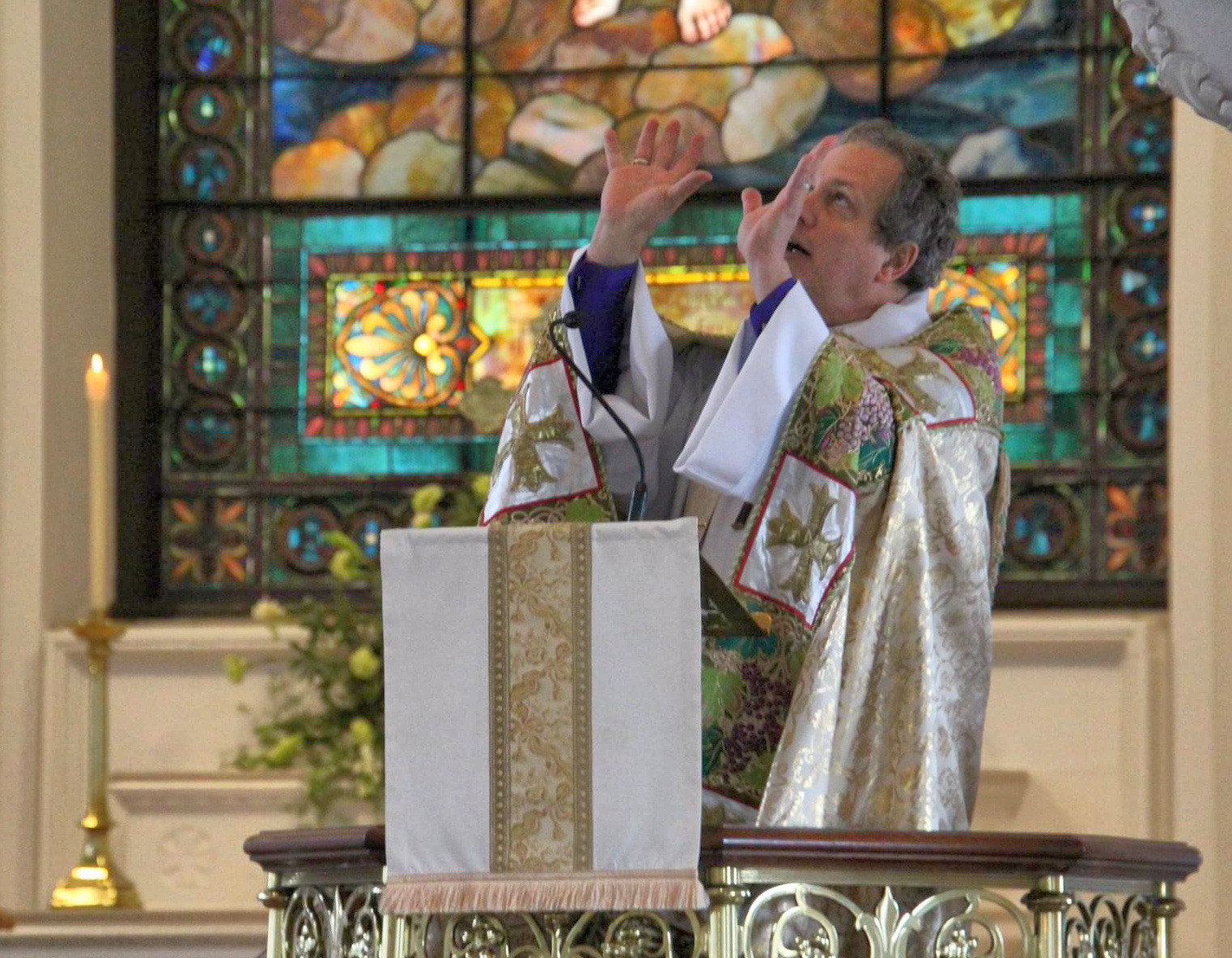 Nothing sounded like Good News to me until I looked at the Gospel passage from below, well below the waters of the Sea of Galilee, seeing a net descending. Okay, I know, a story of nets bursting with fish may not sound like Good News for the fish, but there is something deeper going on here. I stumbled into grace and love when I realized what Jesus did not say.
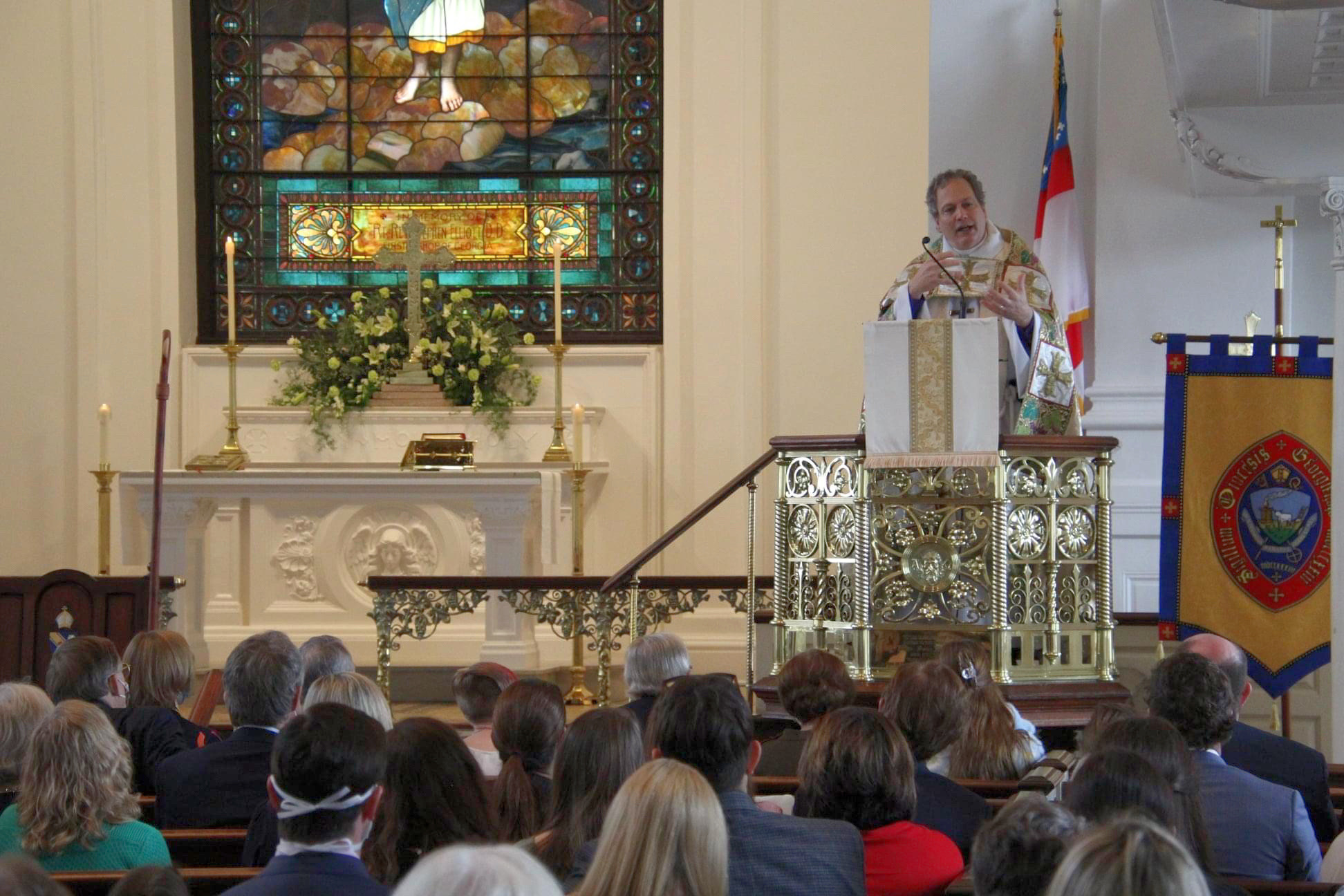 Yet, what we do have as followers of Jesus is a relationship with the God who is working to redeem our world one wild and precious life at a time. What we have is the knowledge that everything we now see and experience is not all there is. The creator of the cosmos knows you by name, has always loved you, will never give up on you, and wants better for you. We have the hope in the God who goes to the depths of human existence to love, truly love, those who see themselves as lost, unfit, and sinful. God is always offering a chance for a clean slate, a fresh start, and will never leave you to the chaos that threatens to consume you. God will send a net.
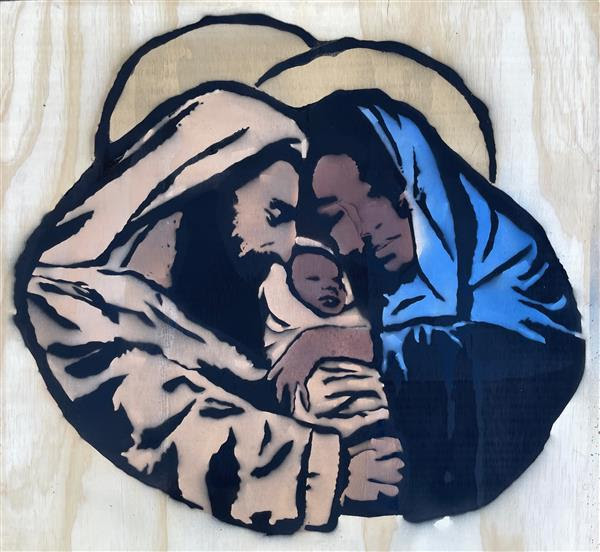 Christmas is the story of human hopes and fears met in the night by the maker of heaven and earth coming to live as one of us. We invariably tell of Jesus’ birth as a night story. It need not be so as the Gospel writer Luke said of Joseph and Mary’s stay in Bethlehem for the census, “While they were there, the time came for her to deliver her child.” Meanwhile Matthew writes of Joseph having a dream and waking to resolve to wed Mary and that after she bore a son, he named him Jesus. At right is Bishop Logue’s graffiti-style image of The Holy Family, which he painted last weekend on plywood, using spray paint and a hand-cut stencil he designed.