Sermon for the Ordination of Ben Jones, Ethan White, and Pierce Withers to the Sacred Order of Deacons
The Rev. Canon Loren V. Lasch Episcopal Center Savannah, Georgia April 18, 2026
A Radical Act Sermon for the Ordination of Ben Jones, Ethan White, and Pierce Withers to the Sacred Order of Deacons Luke 22:24-27
I invite you to take a moment this morning to envision some of the most radical acts you have heard of throughout history. Things that have altered the course of history and worked to put humanity on a better path. Perhaps you like me have thought of things like the suffragette movement, the Montgomery bus boycott, the Stonewall uprising. Or the actions of people like Harriet Tubman, Oskar Schindler, or Harvey Milk.
Now take a moment to look around this room. At the beautiful flowers, the lovely vestments, the liturgical space arranged just so, in order to worship the Lord in the beauty of holiness. At a glance, there is nothing that we do today that resembles the radical acts named above. While Episcopalians are known to be many things…welcoming, faithful, traditional…but radical isn’t really one of them. For instance: our current Book of Common Prayer was written before I was born and we still refer to it as “new”!
However, the ordination of Ben, Ethan, and Pierce to the Sacred Order of Deacons is indeed radical, in the most basic sense of the word: foundational, fundamental, getting down to the roots.
We see the roots of the Jesus movement sprouting very clearly in today’s reading from Luke’s Gospel. Jesus and the Twelve are in Jerusalem, gathered in the upper room for the Passover meal. Previous chapters have seen disciples in close proximity to Jesus as he is preaching and teaching in the Temple. They have heard parables and exhortations designed to prepare them for
God’s reign. They have seen Jesus speak out against worldly power and false piety. And, in the verses just before today’s passage, they have just heard words that likely seemed very strange at the time, but for centuries since have brought healing and hope: “This is my body, which is given for you. Do this in remembrance of me.”
And today we join the disciples as they sit at the Passover table, with those words ringing in their ears, with memories of the previous days of Jesus’s teachings swimming in their heads. And what is the first thing they do? They argue over which one of them is the greatest.
I imagine Jesus did not feel particularly thrilled with this response, given all that he had tried to teach the disciples during their time together. However, instead of replying in anger or frustration, Jesus takes a more radical approach: …”the greatest among you must become like the youngest, and the leader like one who serves.”
This goes against everything the disciples had ever known about greatness. The world they lived in was marked by dominance and power, where greatness went hand in hand with status and might. And yet here is Jesus telling them that greatness instead goes hand in hand with service and care. And beyond that, he tells them that he, who is powerful enough to perform miracles and cast out demons, is among them as one who serves.
This is a foundational, fundamental belief that guides us in our liturgy today: our God serves, rather than dominates, and that is the specific call laid upon Ethan, Pierce, and Ben today. All of what we do here is to set aside these three ordinands to be among us as ones who serve, just as Jesus did. The vows they will make bring them back to the roots of Jesus’s example for us. A radical act.
But the ministry Pierce, Ben, and Ethan are dedicated to this day is not simply serving for the sake of serving. Or even serving only for the sake of sharing God’s love with others. They are called to serve in ways that re-orient this broken world back to health and wholeness, back into relationship with the one who came among us to serve.
Much like in the time of the disciples, our world places value on dominance, power, and might. On taking what’s rightfully ours, on pushing aside those who would get in our way, those we deem unworthy. Again and again we are made to think that empathy and kindness are signs of weakness, that our needs must always outweigh the needs of others.
Deacons are set aside to help us to see that those lessons from the world are nothing more than dangerous lies. There are so many people living under the weight of those lies that need to hear that there is a better way. A way where greatness is measured by the number of lives helped, rather than the number of enemies trampled. A way where getting ahead entails lifting others up rather than tearing them down. A way where success comes through service.
Ben, Ethan, and Pierce, today we witness you become Deacons, and we ask you to be icons of God’s grace and love, to bring the needs of the world to the church and to show us how to reach out our hands to meet those needs, not with might but with care. As you promise to seek not your glory but the glory of the Lord Christ, we ask that you help us do the same, bringing us back to the root of our call as followers of Jesus. We ask you to help radicalize us.
This is a constant refrain in scripture. From Genesis, where God comes to Abram in a vision and says, “Do not be afraid, Abram. I am your shield, your very great reward.” through to Revelation when the Son of Man says, “Do not be afraid. I am the First and the Last. I am the Living One; I was dead, and now look, I am alive for ever and ever! And I hold the keys of death and Hades.”
Fear of their own arrests and death held the first followers of Jesus in its immobilizing grip on the Friday their longed-for Messiah was killed on a cross. On Saturday, they remained bound by that same terror as they huddled together in the Upper Room in Jerusalem where they had celebrated the Passover. Though Jesus had been trying to prepare them for his betrayal and death, those who traveled with him from Galilee had not been able to hold on to hope. In retrospect, we read the Bible and wonder why they were so trapped by fear that they did not see that death could not hold the author of life. They had been present when Jesus said:
“Take heart, it is I; do not be afraid,” as he walked toward his disciples’ boat across a storm-tossed sea.
And they were there when Jesus said, “Do not be afraid,” to the synagogue leader, Jairus, before he brought his daughter back to life.
Yet when we consider our own experiences, we understand all too well how they could fail to see what now seems evident. We know despair can prevent our seeing anything but the possibility of further grief and tragedy.
Panic is our body’s automatic reaction when we feel threatened. That response is healthy in the right circumstances. I am reminded of a mutual flash of terror that kept a venomous snake and me away from one another. We had just finished building the church building at King of Peace in Kingsland. I was waiting for an inspector to arrive. I used the wait time to begin pulling up the erosion control fence between the building and our neighbor’s undeveloped acreage. In reaching around the back side of the fencing to grab a stake, I exposed a water moccasin. The snake’s primitive brain kicked in immediately. It coiled back exposing fangs standing out from the bright-white mouth. My body had an equal and opposite reaction, opting for literal flight rather than fight. In that same fraction of a fraction of a second, I practically levitated, rising from the ground faster than I could fully register what was happening. I landed on my feet, upright and on full alert. My heart raced as the snake quickly slithered away. The adrenaline that flooded my system kept me anxious after the threat had long passed. But that was just my God-given alert system keeping me ready in case of a renewed threat.
In the midst of uncertainty, with so much that matters to us beyond our ability to control, fear is a natural response. That anxious response is a gift in the right circumstances. But as a day-to-day way of living, being on high alert is not healthy. Yet, in this present moment with our world at war, in a nation where divisions are all too evident, experiencing anxiety and dread is common and our fight or flight responses are not helpful. We have to pin our hope on something more powerful than the chaos we see around us.
This is where it matters that we do not place our trust in the metaphor of resurrection for a Rabbi whose teaching lived on. Our faith is built from the conviction that Jesus was not only put to death on a cross, but in his body he was raised to new life, never to die again. His fear-bound followers found their lives transformed by this central fact of human history that “God so loved the world, that he gave his only-begotten Son, to the end that all that believe in him should not perish, but have everlasting life.”
Knowing that the God who made us out of love for love is with us always and can defeat even death itself makes it possible to break the hold fear can place on our lives. Let us begin at Easter with that greatest fear, death. If we can make peace with our own death and the loss of those we love, then so much of the anxiety of living is relativized. Scripture tells us that while death is very real, we do not have to live in fear for ourselves and those we grieve. God remains in control.
As Christians, we can approach death with confidence with the promise of eternal life lived in the presence of God. That promise is not for the future alone. You can also experience something of the hereafter in the here and now by being aware of God’s presence in all the places you find yourself in this life. Just as Jesus was with his first followers after his death and remained with them by the power of the Spirit following his return to heaven. The proof of Heaven is the nearness of God in our daily lives.
And because we need not fear death and we can experience God’s abiding presence within us, we can move from despair to hope in the many other occasions for anxiety in our lives. We worship a living Lord. We can hold in prayer the uncertainty we face or the decisions we are wrestling with, asking the Spirit’s guidance. We can pray for God to close the wrong doors, barring even what seems like the most promising of paths if it is not God’s will. And we can ask God to show us the way we should go, knowing that even if it looks impossible, we will know it was God’s desire when what looked like a wall becomes the way forward.
In whatever you are confronted with now or you have to deal with in the future, know that the love that is within the Holy Trinity that we see most fully in Jesus is with you. In every moment of doubt and uncertainty, recall that the creator of the cosmos who knows you by name will never leave you or forsake you. This does not make the problems of life any less real from the smallest of worries of your day to the immense tragedy of the death of someone you love. But rather than merely having the fight or flight options you can choose to abide, knowing that the One who is present in you is greater than the one in our fear-filled world. For you have the comfort of how God has been with you in the past and the knowledge that the one who holds the future is with you now, so you are attuned to hear more clearly that constant refrain we find in scripture:
The Rt. Rev. Frank S. Logue St. Matthew’s Episcopal Church Savannah, Georgia January 19, 2026
Dangerous unselfishness A Reflection on MLK Observance Day in Savannah
“All we say to America is to be true to what you said on paper.”
The Rev. Dr. Martin Luther King, Jr. said these words in a speech at the Mason Temple Church of God in Christ in Memphis, Tennessee, on April 3, 1968. He was in town with other leaders of the Southern Christian Leadership Conference to support the Sanitation Workers Strike.
“All we say to America is to be true to what you said on paper.”
We know that at 6:05 the next evening, Dr. King would be martyred by an assassin’s bullet at the age of 39.
We don’t have to wonder if he knew this could happen. The first assassination attempt on Dr. King had come a decade earlier in a store in Harlem. Many death threats had followed, and on that night before he died, Dr. King told those gathered ahead of a march, “Well, I don’t know what will happen now; we’ve got some difficult days ahead. But it really doesn’t matter to me now, because I’ve been to the mountaintop. And I don’t mind. Like anybody, I would like to live a long life – longevity has its place. But I’m not concerned about that now. I just want to do God’s will.”
His main message that night was not about the likelihood of his death, but the challenge of solidarity with the threat of violence hanging in the air for those who peacefully protested.
His message to African Americans, and any allies supporting them in that strike in Memphis, was to stand firm, stay the difficult course. He said, “We need all of you,” as he emphasized the non-violent actions of withdrawing economic support from targeted businesses while marching in favor of change effected through public policy made easier by the thousands marching in the streets for justice.
Dr. King said, “All we say to America is to be true to what you said on paper. If I lived in China or even Russia, or any totalitarian country, maybe I could understand some of these illegal injunctions. Maybe I could understand the denial of certain basic First Amendment privileges, because they haven’t committed themselves to that over there. But somewhere I read of the freedom of assembly. Somewhere I read of the freedom of speech. Somewhere I read of the freedom of press. Somewhere I read that the greatness of America is the right to protest for right. And so just as I say we aren’t going to let any dogs or water hoses turn us around, we aren’t going to let any injunction turn us around. We are going on. We need all of you.”
He would add later in the speech about the next day’s march, “Be concerned about your brother. You may not be on strike, but either we go up together or we go down together. Let us develop a kind of dangerous unselfishness.”
Dangerous unselfishness. This is what caused Moses to leave his father-in-law’s flocks to go back to Egypt to bring the Children of Israel out of slavery into the Promised Land.
Dangerous unselfishness. This is what animated the hearts of the prophets to speak truth to power, even when it cost them their lives.
Dangerous unselfishness. This is what got Jesus nailed to a tree. For Jesus would not give up on love, even when the price was death. Jesus remained unselfish to the last, praying for those in the very act of crucifying him, saying, “Father, forgive them, for they know not what they do.”
Jesus called us not just to love the Lord our God with all our heart, mind, soul, and strength, but also to love our neighbors as ourselves. Then in our Gospel reading for today from Luke, Jesus raises that bar in saying, “I say to you who are willing to hear: Love your enemies. Do good to those who hate you. Bless those who curse you. Pray for those who mistreat you.” This love of those who ate the side of hatred is what calls us to non-violent action.
This is the dangerous unselfishness that put the Rev. Dr. Martin Luther King, Jr. in the crosshairs of a rifle on that Memphis evening. Selfless acts done for those who would otherwise be lost, left out, or marginalized disrupt the status quo, and that selflessness can still get you killed.
Dangerous unselfishness comes from knowing that every person is made in the image and likeness of God. This drives our need to seek and serve Christ in all persons, loving our neighbors as we love ourselves, and to strive for justice and peace among all people, and respect the dignity of every human being.
There is so much noble and good and true in this nation, so much to cause our hearts to swell with the pride of citizenship. Yet as deeply true as that rightness is, more often than we want to admit, it feels like America has not being true to what it says on paper. We continue to see immeasurable injustice and unfathomable cruelty through the abuse of power.
When we see that we are falling far short of our ideals, we are to lean harder into the love Jesus taught.
Jesus taught love in his every word.
Jesus taught love in his every action.
Jesus proclaimed and lived out the love of God, the Holy Trinity from his baptism in the River Jordan, through his death and resurrection, to his ascension to the right hand of the Father promising to be with us always, even to the end of the age.
The witness described and lived out by Dr. King reminds us again and again that none of us can be truly free until everyone is free. When we see our neighbors suffering, our faith compels us to take a stand that disrupts the powers of this present age. This comes at a cost, yes. The cost of inaction in the face of injustice is higher.
Our call as followers of Jesus is the same today as it was when Dr. King spoke in Memphis.
Our call is the same it has been since Jesus showed us God’s immense and unconditional love by becoming Incarnate among us.
Our call is to truly care for each and every child of God, loving as Jesus loves.
“You will find a child wrapped in bands of cloth and lying in a manger.” With these words, an angel of the Lord brought good news of great joy to all people. The divine Word, present as the Holy Trinity created the vast cosmos could never be contained by all creation. That Word made flesh would be found wrapped in bands of cloth. God became incarnate, emptying God’s own self to be born in Bethlehem. The object that gave the shepherds the key clue to finding the right newborn was “manger.” They were to discover the King of Creation by looking amongst the livestock for an infant whose parents pressed a food trough into service as a cradle.
The manger served as the fulcrum for the lever that would turn the world right-side up once more. Jesus’ mother Mary, the God bearer, made this abundantly clear in her prophetic hymn of praise, the Magnificat. Mary exults at a reversal of fortunes as God is faithful to promises made in ages past by bringing down the powerful and lifting up the lowly. The rich are sent away empty, while the hungry are filled with good things. As Jesus would later say, “The last shall be first and the first shall be last.” “The one who would be the greatest must be the servant of all.”
Mary had none of the outward appearance that those in first-century Palestine would associate with God’s blessing. She was neither rich nor had any earthly power. Yet, she sang of God’s promises being fulfilled with verbs all in the past tense. She could see clearly that, as God had noticed her and called her blessed among women, then the world was as good as turned upside down, which was to set it back as it was meant to be.
This brings to mind for me a Jewish expression captured in a hymn sung during a Passover seder, the Deyenu. The compound Hebrew word “deyenu” means “it would have been enough.” The song recounts all that God did to deliver the Hebrew people out of bondage to Pharaoh. So that one proclaims, “If God had taken us out of Egypt and not made judgments on them; it would have been enough” and continues through step by step until, “If God had brought us into the land of Israel and had not built us the Temple; it would have been enough.”
I return to this hymn in my mind again and again when something marvellous happens and I think that if this alone is all God did for me, it would have been enough. In the form of the Deyenu, “If God had allowed me to baptize this teenager and no one else, it would have been enough.” Or perhaps, “If God had let me be with this family as we prayed last rites together and nothing else, it would have been enough.”
Christmas recalls the greatest of these “it would have been enough” moments: “If God had become human in a baby found wrapped in swaddling clothes and lying in a manger; it would have been enough.” God becoming human in Jesus changed everything. The God Bearer Mary was so very right in singing that with the birth of Jesus, the world is good as turned aright once more.
I can recall so well the magical feeling of a Christmas morning walk in an overgrown field behind our house when I was back home on break from college. This was wild land as an array of weeds and small trees competed with one another as they took root on the empty lot.
I had outgrown the yearning for presents that characterized Christmases of my childhood. I was enjoying the seven of us together. I don’t remember what gifts I received. I do remember feeling good about the morning of unwrapping gifts in a calmer way than my four siblings and I could have managed when we were younger. The morning felt just right, with nothing else needed. Then, my dad brought out one last, not-particularly large, gift-wrapped box. He seemed so pleased. I had no idea what it could be. Inside, I found the unexpected gift of a Nikon camera. Until then, my forays into photography had been with my dad’s old Yashica. This was a Nikon of my own.
It was still early enough that when I went out after breakfast, the fog that enshrouded that morning had yet to break. I took my gift for a walk to see what I could see. The dew-covered weeds overtaking the lot seemed magical to me. Quiet stillness is what I remember. No noise except the occasional bird sounds. The photos I took that morning would never make it to a nature calendar, but they were the beginnings of me gaining a better sense of capturing my perspective on the world through a lens. Photography encourages me to pay close attention to what I am seeing and then attend to how I frame what interests me so that I can share my perspective with others.
Over the next few years, I started working for Georgia Southern’s student newspaper, then the yearbook, the Public Relations Department and the Statesboro Herald. I would graduate and take a job as a newspaper photographer first in Warner Robins and later in Rome, Georgia. I honed my craft in newspaper work so that shutter speed and aperture and the rules of composition became second nature. I still enjoy that part of photography, the technical side. Then, when I had an assignment to get a photograph of a given subject, like the office manager whose passion was playing for the local symphony, I could use that craft to get a technically good picture for the paper. But the art of photography, which continues to draw me in, comes in discovering the world in surprising ways through attentiveness. This way of seeing the world is as much about feeling as seeing. How does this feel and how do I convey that feeling?
I now understand how the two ways I practice photography–the first with a set plan of what I need to document or show, the second going out and discovering what captivates me–are an apt metaphor for two ways of being with God–in saying our prayers and being prayerful.
This summer while on sabbatical, I read Brother David Steindl Rast’s book Gratefulness, the Heart of Prayer: An Approach to Life in Fullness In it, Brother David writes, “It is not prayers that count, but prayerfulness.” In unpacking this for myself, I could see anew something I had already experienced, that we need both of these: the prayers of the church and a prayerful attentiveness to life.
In finding my way into the Episcopal Church, I was drawn by Word and Sacrament in the liturgy where scripture is taken seriously as the Word of God, as are the outward signs of the inward and spiritual grace we find in the sacraments. I found myself pulled into the Anglican way of connecting myself more fully to Christ through threefold practices found in the Book of Common Prayer of weekly Communion, Daily Office, and private devotions. Decades ago, I added daily prayer using the offices of Morning and Evening Prayer to my gathering weekly with others for the Holy Eucharist, and then I added other private devotions, including other forms of prayer, as well as confession. The discipline in this simple way of living offers a life of prayer that shapes one over time. As the water of a creek flowing over stones smooths off the rock’s rough edges, so this ongoing pattern of prayer shapes my soul. But these prayers, as vitally important as they are, do not encapsulate all of my worship of God, the Holy Trinity. These disciplines nourish me even as they open up a prayerful way of living that encompasses my whole life.
Brother David put it this way in his book Gratefulness, “It happens that people who are in the habit of saying prayers at certain set times have their moments of genuine prayer precisely at times when they are not saying prayers. In fact, they may not even recognize their most prayerful moments as prayer. Others who never say formal prayers are nourished by moments of deep prayerfulness. Yet, they would be surprised to learn that they are praying at all.”
Here, he is getting at something people who identify as spiritual, but not religious, get precisely right: we can experience God as fully in nature as we do in the worship of the church. We get a powerful sense of connection to the divine in the beauty of a sunrise, a star-filled night sky, a waterfall, or through the little world glimpsed inside drops of dew hanging from weeds that died back for winter in a field on a Christmas morning. These moments of wonder point to a deeper reality that binds the world together in ways we could otherwise miss. Those of us who do identify as religious discover that the God we glimpse in creation is known more fully in the specific revelation of scripture, and most fully in the person of Jesus of Nazareth.
A prayerful way of engaging with creation will reveal that there is infinitely more to life than we might first be able to perceive. This is where the life of prayer comes in. That simple way of being that is at the heart of Anglican spirituality is shaped by weekly Eucharists, where we encounter God in Word and Sacrament in the midst of a given group of people; the daily offices where structured prayers and scripture reading together with intercessions for ourselves and others further hones our spiritual imaginations; and also through other devotions including confession through which we acknowledge the ways we have fallen short. All of these are Means of Grace that the Holy Spirit uses to enlighten the eyes of our hearts. Then we begin to see God in more and more places until we realize that the God who transcends all creation is also working in and through all this fallen world, including you and me.
Our prayers feed our prayerfulness; they give us the eyes to see and know God through scripture, through time of structured prayer, through the sacraments, and all of these point us to God the Holy Trinity, who is beyond all and in all. This allows us not just to see and know the creator of the cosmos in a stunning sunrise, which can be soul-stirring, but to also know the presence of the living God in the emergency room and in Hospice Care, and in the difficult days we face in our lives.
That Christmas morning with my new Nikon lit a spark of wonder in my soul. Photography continues to encourage me to really see what I am seeing and to pay attention to the world around me. The life of prayer does this work by giving us eyes to see God in ways we would otherwise miss.
As we journey toward Christmas, through this season of Advent, which is a time for preparing not just for a babe being born in Bethlehem, but also for Jesus’ return in glory, may the Lord bless you and keep you. The Lord make the light of his face shine upon you and be gracious to you. The Lord lift up his countenance upon you and give you peace.
Closing Remarks to the 204th Convention November 8, 2025 The Rt. Rev. Frank S. Logue
There is no I in Team
When I arrived here at Georgia Southern as a Sophomore, I got jobs shooting photos for the school newspaper and the school’s PR department. This gave me an insider’s view into the football program as I was here as the founding head coach, Erk Russell, arrived to start building a team. I was there for their first practices, the first day in pads, and their first game, played at the Dublin High School stadium. I was aware of his reputation as a defensive coordinator for the Georgia Bulldogs, who coined the nickname “Junkyard Dogs.” After 17 years there, he went out on top. UGA had just won a National Championship when Erk resigned to take the job here in Statesboro.
They had no real inducement for new players for an unknown team, offering neither prestige nor scholarships to drive recruitment. Erk scoured high schools, junior colleges, all around looking for players with untapped potential. My roommate, John Sharpe from Vidalia, who left a scholarship position playing for Georgia Tech to play for Erk. John never regretted the move, as he got to be part of building something special alongside players I got to know well from practices and the sidelines of games. I was there when he named the nasty drainage ditch in the midst of the practice fields Beautiful Eagle Creek. I watched them pour out a jug of this Eagle Creek water to claim a field far from Statesboro as their own home turf.
In those early days, Erk often wore a T-shirt with the word “TEAM” written in huge capital letters that dwarfed the word written beneath it, “me.” Big Team. Little Me. This was Erk’s way of showing there is no I in team. Erk would bring home three NCAA Division I-AA championships. The Cinderella story was possible because Erk Russell convinced the ragtag group of players that, as a team, they could be better than any of them were as individuals.
I could now change to my Youth Pastor’s Voice and say, “You know who turned a ragtag group into a team that transformed the world?” The answer to any such question asked in Youth Pastor Voice is always…[wait for someone to say it]. Yes, Jesus.
Y’all have heard a lot of sermons in your lives. I don’t have to belabor the connection between building a football team and our plan to Encourage, Strengthen, and Love One Another. The Apostle Paul had felt in his marrow the ineffable joy of being in communion with other Christians through being in communion with God, the Holy Trinity. Out of this experience of the koinonia, that essential unity for which we were created, he knew that we, the people who are the church, were not meant to worship and serve in isolation, but as part of a larger community. The Apostle Paul created a powerful image for how the individual members of the church come together to do more than any could do on their own when he wrote about the members of a body. In his rousing halftime pep talk to his team in his First Letter to the Corinthians, where the 12th Chapter is all about how “Y’all are the body of Christ.”
I know whatever translation of the Bible you read does not say “Y’all,” but in Greek the word is plural. Paul meant “Y’all.” Paul wrote to the local church in Corinth that he knew well to remind them that they are part of the larger Body of Christ, which is the total of all the Christian churches. Paul compared the church to a body, because it gave him a great way to show how every person in the congregation is essential. The feet need the hands, the hands need the eyes, and on it goes. The Apostle to the Gentiles goes to almost comic lengths to make his point that no one is better than another in writing: “The members of the body that seem to be weaker are indispensable, and those members of the body that we think less honorable we clothe with greater honor, and our less respectable members are treated with greater respect, whereas our more respectable members do not need this.”
This points to the truth that the Holy Trinity never, ever, not even one time, gives all the gifts to one individual. We are made to be in relationship with God and with each other, which is why so much of the New Testament describes the practical, daily living out of koinonia in how to be in community with one another.
As a new Episcopalian, I was surprised to learn that in the Anglican Communion, the primary unit of organization and governance is a diocese. I grew up here in the Deep South where congregationalism is in the groundwater in a nation that praises the rugged individual who makes their way on their own. Yet, within our tradition, we acknowledge that a parish is not meant to remain in isolation, but within the vital network of connections that exist within a Diocese. This makes sense as every church does not need to maintain the capacity to raise up its own clergy, train them for ministry, and ordain them as deacons and priests. That work, that supports the individual parishes, happens well in a Diocese. The same is true with the many elements of the strategic plan, which build on the strength that exists within our network of churches
As I said last evening, independence is an illusion as we all need others, and we are not meant to be fully dependent on anyone or anything but God alone. What we are meant to be as people and as the Body of Christ is neither dependent nor independent, but interdependent. This interdependence is a way of expressing the close partnership and participation within our diocesan community that is flows not from us, but from the communion already present in the divine life of the Holy Trinity. As individuals, we are interdependent, each of us needing others from time to time, and as congregations, we are to be interdependent as well, each of us much better off for the connections we share.
When we get out of our parish, as everyone here did to take part in this diocesan convention, we discover the richness of these connections. I have watched the change that happens when a 3rd grader takes part in the Acolyte Festival, a Middle Schooler makes it to New Beginnings, and adults go to Cursillo. This also happens with the Lay Ministers Conference and Lay Worship Leader Training and over the last 15 years, I have seen this in people taking part in the Church Development Institute and Leading with Grace. It is life-giving to find yourself part of a larger group of Episcopalians with whom you are already connected. It is such a great gift to find others whose struggles and joys so match your own. It is a short step from watching the varied people who showed up for a weekend find friendship to enjoying seeing people gather for our convention to see how many of you arrive grateful to see others you have met through these types of gatherings.
This move from a parish focus to seeing our local parish as an integral part of a diocesan community is truly transformational. A given congregation need not be omnicompetent to thrive, as the gifts are likely already present in the Diocese, and if not, they will be found in the larger Episcopal Church. When you realize that you are already part of a bigger team and you make the effort to connect with others, you will find not just an increase in knowledge or capacity, but a greater sense that you are not alone. You are part of an interdependent web of connections that comes from being in communion with everyone that God is in communion with, which Paul described so perfectly as the Body of Christ.
The challenges we face are significant. But we have continued to operate like the church of prior generations, when we could sit back, hoping folks would find us and, in our worship, find Jesus, without our needing to offer a word of invitation or welcome. We could try harder at pretending to be the church of the 1950s, but in so many ways, that ship has sailed, which is great, as that church was not open to the gifts of the whole community.
Our way of being the Body of Christ must respond to the times in which we live, not by bending the Gospel to meet the wisdom of a given age, but by bringing the eternal word to the communities we serve in our given time and place. In the 1950s and 60s, when church attendance was assumed of good people in Central and South Georgia, we could assume that being a successful church meant a full-time professional for every parish leading a congregation with fully staffed committees and a robust Sunday School while being a successful mission meant working with our professional, paid for in part by the Diocese, toward that goal. Yet, the Diocese of Georgia thrived in earlier generations when being the Body of Christ did not assume this model and yet we did in those previous generations assist more neighbors in coming to know Jesus.
Rather than holding out for the ideal of a post-World War II church boom, we are to do what we can for Jesus where we are with what we have now. Right now, with no additional resources, we can encourage and strengthen one another into being the fullest expression of the Body of Christ that our community can sustainably offer so that more of our neighbors will come to love Jesus as we do.
If we work on our own faith, while right-sizing our expectations, we can grow in grace and share the love of God with others. We can encourage parishioners to use their gifts within the church and the community through formation for every age and stage of life that emphasizes the practices we know nurture more Christ-like lives even as we encourage more vocations to ordained ministry. We can support lay leaders, clergy, and congregations in shifting the business side of church to align with our current resources in this new landscape for our ongoing mission and in this effort, clergy and congregations will support one another directly, and through convocations, as well as through the Diocese. And we can do all of this in service of more fully showing love for one another as we get beyond our welcoming red doors into our neighborhoods in ways that fit our congregation so that more people experience this love. I began with what I experienced here in Statesboro, when an inspirational leader pulled off what felt like a miraculous start for a new team. Make no mistake. I am no Erk Russell. I am just the guy using his Youth Pastor’s Voice to remind us that the team we are on is led by Jesus. Y’all are Christ’s body. And I know as we forge more connections among us, the Holy Trinity who created us out of love for love will do more than we could ask for or imagine as we head into the dynamic direction this plan points us toward. As always, I am glad to be on this team with you.
The Rt. Rev. Frank S. Logue preached this sermon at Trinity Episcopal Church in Statesboro, Georgia, on November 7, 2025.
Turning the church outside in An ordination sermon for the 204th Convention of the Diocese of Georgia Luke 10:25-37
Imagine with me a trip to the County Fair. It’s blue dark on a crisp fall evening. As you walk down the row of carnival rides and games you find yourself drawn to the Fun House Hall of Mirrors. You enter, going by a line of odd-shaped mirrors. First, you are tall and thin and then short and fat and then your head is impossibly tall on a little body. Next you make your way into the maze with plexiglass and mirrors making it difficult to know which way to go. Everything is so confusing. Once inside, you discover the maze is impossibly vast, like a whole other world within what had seemed like every other attraction on the row of attractions at the Fair.
Stay with me in your imagination, as this Hall of Mirrors is going to reveal something about what we are doing this evening in ordaining three servant ministers to serve the communities around our churches. Back in the Fun House, you continue to ramble through the mirrors and plexiglass, you sometimes see a seemingly infinite number of versions stretching out in front of you and there in the other direction when you turn around. Some rooms within the Fun House defy explanation as in one you feel you are walking sideways or in another you seem to grow small as you cross the room. When you walk back the way you came, you feel like you are growing taller. The cleverly designed space is tricking your eyes, but even knowing that, it is challenging to not give into the distorted perspective.
Impossibly deep within this strange carnival attraction you begin to meet people who live within the maze of mirrors. They don’t know that there is a world outside these walls as this is the only place they have ever lived. Everyone they know has lived their while lives within this place. You try to explain to them what the world is like just outside the confines of this weird fairground attraction, but they know nothing else. You try to explain the world outside, but how can you get them to understand the real world?
This image may seem a bit far afield from Encourage, Strengthen, Love One Another, but I begin with this imaginary journey into a distorted world to offer a different angle from which to see the ministry of Jesus of Nazareth and so to see the work of Christ’s Body, the church. The second person of the Holy Trinity entered into a creation turned from God. Jesus preached that the last shall be first and the humble will be exalted and it sounded to those who heard him like he wanted to turn the world upside down. Then as he talked about the outcasts being central to the community and the marginalized as those for whom we offer the greatest care. This sounded like he wanted to turn the world inside out.
Jesus teaching us to love one another was well and good, but he also taught us to love our enemies and that sounded extreme. But this is not what these statements would have felt like to Jesus. For the Son of God knew what the Kingdom of God is like, and so he knew how our world was meant to be. He wasn’t turning the world, upside down and inside out. Jesus described reality to people living in a world distorted by sin and shame, people who don’t even realize how different this world is from the one of grace and love that Jesus knows and desires to lead them into.
We see Jesus’ subversive style of cluing us in on reality in our Gospel reading for this evening, with one of Jesus’ Greatest Hits, The Parable of the Good Samaritan. An expert in Moses’ law who knew he was to love God with all his heart, mind, soul, and strength and to love his neighbor as himself asks Jesus to define neighbor. The expert on the Torah is starting with himself and looking outward in concentric circles to find out who is in and who can be out, how far does he have to take this faith thing.
Jesus then tells the familiar story of a man attacked by robbers and left beaten and half-dead at the roadside. Using a mere 96 words in the Greek New Testament, Jesus gives us one religious leader followed by another who each pass by the gravely injured man. Finally, a Samaritan, the epitome of The Other, goes above and beyond any expectation as he lends the man aid. He spends a good deal of time and pledges all the needed money to make sure that the Israelite can rest and recover. Then Jesus asks the lawyer, “Which one of the three, do you think, was a neighbor to the man who fell into the hands of the robbers?” The expert in Torah said, “the one who showed him mercy.”
What draws me back to this example again and again is that it allows us to see the inside-out compassion of God. The question was “Who is my neighbor?” With the keyword “my,” the question presupposes that I am the starting point and the question is “How far do I have to go?” Jesus turns the question outside-in by starting with the person in need. Jesus asks, “Who is the person closest to the man in need?” If you see a need, if you know of a need, then you are a neighbor. Jesus taught us to show godly compassion for one another, but then cleverly included everyone in the one another we are to love and even made the one in need the starting point, the center of the concentric circles.
Our Presiding Bishop, Sean Rowe, told the joint clergy conference of the Dioceses of Georgia and Atlanta that met in September, “We do the Christian gospel and the Christian message a disservice when we think of ourselves at the middle and then we think of ourselves as expanding the boundaries to include all people when really, it’s the other way around.” Rowe described the lost, the left out, the marginalized as being at the center of God’s loving concern. Those most in need are most on the heart of the Holy Trinity. Referring to the work of Episcopal priest and theologian Dr. Kelly Brown Douglas, Bishop Rowe said that those that seem on the margins “…are at the center of the story. They’re the bearers of the salvation of the world, their struggles reveal to us the kingdom of God. And so, as witnesses of the gospel, we put their story at the center. So, when we when we reach out, we’re reaching out to the center. We’re going to the center, rather than extending the circle.”
This is the outside-in message of the Kingdom of God that Jesus proclaimed to a world turned from God. Like the last being first and the humble being exalted, Jesus put the margins in the center. This is the ministry of a deacon. In the words of the Ordination Rite for a Deacon, “In the name of Jesus Christ, [deacons] are to serve all people, particularly the poor, the weak, the sick, and the lonely.”
This servant ministry is central to the church’s work. For I will pray for Lynn, Jamie, and Deb, “As your Son came not to be served but to serve, may these deacons share in Christ’s service.” These three servant leaders do not come to this day because we hope that the Holy Spirit will use this ordination to turn their hearts outward in service. It is because we have seen the light of Christ in each of them, revealed in the compassion they have already expressed for the poor, the weak, the sick, and the lonely, that we ordain them today.
As a teen, Jamie spent her summers volunteering through the Red Cross as a Candy Striper at the local General Hospital and she also served as a camp counselor with special needs children. Jamie says these experiences proved valuable and instilled in her compassion and respect for all, regardless of their circumstances. In 2008, she found the Episcopal Church at St. Martin in the Fields in Dunwoody, Georgia and became a Daughter of the King there. When Jamie and her husband, Obie, moved to St. Simons Island, they connected to Holy Nativity and there Deacon R.V. Cate trained her as a Lay Eucharistic Minister and gave her a vision for how the service to others that had always been part of her life fit the ministry of a deacon.
Deb was raised in a staunchly Roman Catholic family with routine Mass attendance and active participation in the Confraternity of Christian Doctrine forming the foundation of her life of faith. When her professional career in sports television production opened the way for her to become a producer of open-wheel racing for ESPN and ABC Sports, Deb continued to go to Mass on Sundays. But it was at Christ Church Frederica when, during the lockdown of the pandemic she found herself going door to door with a partner wearing gloves and a mask to care for neighbors through the church’s backpack Buddies Ministry. Deb saw the face of Jesus in those she was serving, which she described as like a veil lifted from her eyes.
Lynn grew up at First Baptist Church in Savannah, where her Dad was a deacon and her mom a Sunday school teacher. Her home church was active in community outreach and her youth group did work projects to assist persons who were homeless and others in need. A cousin with Schizophrenia showed her how no one made casseroles for those needing care for mental illness and the faith community was usually silent or absent. When visiting the Church of the Good Shepherd in Augusta more than 25 years ago, she learned they were starting a mental health ministry. The Reverends Andy Menger, John Warner, and Curtis Johnson were all part of the Coalition for Mental and Spiritual Health Ministries that later became an interfaith effort.
The Holy Spirit led each of these women to use their considerable gifts in service of others. This is, of course, what we are all to do as baptized Christians, to serve others as if we are serving Jesus and we are also to allow others to serve us. This mutual care best reflects the love of the Holy Trinity. The Holy Spirit guides away from dependence on anyone or anything other than God. The Spirit also guides us away from total independence, which is actually an illusion as none of us is truly self-sufficient throughout our whole lives. We all have gifts, and we are all in need. What we are meant to be as people and as the Body of Christ is interdependent. Individuals are interdependent, each of us needing others from time to time, and congregations are to be interdependent as well, each of us being better off for the connections we share.
The New Testament spends a good deal of time telling us how we can better live in community. There are 42 verses, which use the words “one another” telling us how we should treat each other. Those verses tell us to do things like “love one another,” “support one another,” and to “provoke one another to love and good deeds.”
I am constantly amazed at how much of scripture is not about me, but about us. You need your neighbors to even start to fulfill God’s commandments. To really live into your faith, you need to worship with a community of Christians and any group of Christ followers will also need to put their faith into action. We do this by serving those in need, and then learning to accept the care of others when we are the ones in need.
Deacons are icons of the servant ministry that embody this call. When deacons are doing their work of taking the church out into the community and bringing the needs of the community into the church, more of the congregation is challenged to join them or to find their own way to serve. This is how deacons encourage and strengthen the faithful into loving one another as Jesus loves us. This is also how we turn the world outside in again, by getting out of our own needs and concerns enough to see the face of Christ in others and to be amazed as they see the face of Christ in us. In doing so, we see the world rightly.
The lost and hurting world, so distorted by sin and selfishness that it feels like a maze of mirrors, needs us to better care for one another and to do so centering those most in need, just as Jesus located the starting point of his parable we read this evening on the man beaten and left for dead. Serving others as if we are serving Jesus is part of the ministry Lynn, Jamie, and Deb are being ordained to do, but rather than serving others on our behalf, they are to call us to join them in this life of service, according to the gifts God has given each of us. The more we are drawn into this loving service, the closer we find ourselves to the heart of God.
Looking back to see what God has done in and through the people and congregations of the Diocese of Georgia is a critical part of the work of our annual conventions. As our 2024 convention was coming to a close, I said, “We need not manage decline as there are ways we can do more.” I pointed back to how the Byllesby Center in the Augusta Convocation and the work of Glynn Episcopal Ministries provide examples of how congregations working together can accomplish more than anyone serving in isolation ever could.
In the Convention Book, you will find four charts that show the reality of our statistics since 2015, including the very real decline in Sunday attendance we have experienced in the past decade. The steep drop of the lockdown of the pandemic is evident, as well as the bounce back that has not taken us to pre-COVID-19 numbers. We provide on one chart some context from other Christian denominations with their percentage change in worshippers on Sunday. You can see that our trend is very much like the rest of the Episcopal Church, and that we are also in line with the Southern Baptists in Georgia. Our rate of change shows us faring better than our ecumenical partners in the Lutheran Church, while not as well as the attendance changes reported by the Assembly of God in Georgia or the Savannah Presbytery, which provides a small sample from the Presbyterian Church.
But these charts are not the whole story. As your Bishop, I get a broader perspective from visiting every congregation in the Diocese. That view provides me with a realistic hope as week by week, I hear the stories of people who are so grateful to have found their local Episcopal Church. In confirming people and receiving new parishioners, I get a steady dose of these stories even as I get to take part in baptisms of more teens and adults than you will see in any given congregation. I am far from alone in seeing this hopeful trend. While we have had a baptism at Honey Creek Summer Camp in prior years, this summer our spiritual directors baptized two teens at High School Camp and two campers at Middle School Camp.
You will find charts of confirmations and receptions, alongside baptisms, and adult baptisms in the book as well. Even with declining attendance, we see those numbers bouncing back now in ways that fit what I am seeing in my travels. We have also seen Cursillo thriving once more with two weekends a year bearing the fruit we have come to expect from those retreats. Yes, attendance is not back to where we were and yes, the number of lives changed by the Gospel of Jesus Christ is more than we should expect given that decrease. God is not done with the Episcopal Diocese of Georgia. The Holy Spirit is working in and through us and sometimes in spite of us to touch the lives of people who need the grace, mercy, and forgiveness we have found.
Since our last convention, I made 44 visitations to congregations, as well as visiting Episcopal Day School and the Byllesby Center, for 46 of the 70 visitations that make up my now usual 18-month cycle of visits. I had the privilege of officiating three ordinations since we last met in convention, and God willing and you, the people, consenting, I will ordain three persons to the Sacred Order of deacons during this convention.
We moved our diocesan offices from the beautiful 1880’s house on 34th Street in Savannah to the location of the former St. Michael and All Angels on the corner of Washington and Waters Avenues. This is a clear example of doing much more than managing decline, as our offices now share a home with ministry to our neighbors. I would be remiss if I did not note that the final move came with me on a ten-week sabbatical approved a year earlier. I planned for the time of rest and renewal to come after the changes underway were completed, but that was not to be. Your diocesan staff, assisted by Dr. M.J. Harris, who managed much of the process for the move, proceeded well. I never once worried while away if the needs of the Diocese were being met. I am so thankful to the whole staff for that and especially for our Canon to the Ordinary and Chief of Staff, the Rev. Canon Loren Lasch who took on everything on my plate that the canons allow. Having fulfilled that role during Bishop Scott Benhase’s 12-week sabbatical in 2016, I know the demands it placed on her. In close consultation with the Standing Committee, she kept everything well in hand.
This past year, as you can see in the videos for this convention, the Diocesan Strategic Planning Committee has put in hard work to use the considerable input you offered in listening sessions and in our last convention to chart a realistic path forward. This is not a static plan to print in a binder and put on a shelf, but a dynamic direction in which we will continue to encourage one another to be imaginative and bold in responding to the challenges we face while strengthening existing programs and stopping those no longer needed as we focus everything we do on love, loving the Lord our God with all our heart, mind, soul, and strength and loving our neighbors as ourselves. The model we have taught for years through the Church Development Institute and Leading with Grace is to Do-Reflect-Do. This means discerning a change to put in place, making that shift and then assessing how it is going to assist us in adjusting the new things we are doing together. That process will see the strategies and goals evolving in the coming years as we iteratively adjust this plan.
As the plan was emerging, we could see areas that we could easily begin addressing and so we got to work even as the plan continued to come together. Hearing frustrations in the listening sessions, I appointed a Communications Committee with input from the Strategic Planning Committee and two persons who are members of both. They have begun work with our Communications Manager, Liz Williams, on aligning our communications with the needs of the Diocese. This includes not just a significant rebuild of our website, but also the new Resource Hub built by the Rev. Charles Todd, through which we offer the means for wardens, administrators, and other leaders to be able to communicate with one another for mutual support while linking ready-to-use resources. The Episcopal Church is working with public relations experts to create branding resources that we will, as intended, tailor to our context. We have looked longingly at other denominations who did this work in years past and now we have a churchwide effort that will benefit us in Georgia. We will assist you in using the elements of the campaign now in the works to make this easy for congregations without the talents in-house for this communications work.
We also heard a desire for more spiritual formation, especially given that every congregation does not have the capacity for new offerings or can’t make something available at times that fit every parishioner. In his new role as our Canon for Congregational Vitality, Canon Joshua Varner began leading online discussions of our 1Book1Diocese reads and then piloted a new program using the BeingWith Curriculum created by St. Martin’s in-the-field in London. Created in pandemic, this is a way to engage those curious about faith in Jesus who are “on the edge of church — uncertain, disconnected, hurt, or simply searching for something deeper.” The initial group went well and we will now roll out more groups online and in person, beginning this January. The few spiritual formation offerings I name here are not an attempt to handle the concerns raised with diocesan staff alone. They are pilot projects that will be added to by others in the Diocese, bringing yet more offerings, so that what one church is doing can benefit others in their convocation and beyond.
Joshua also worked with the Revs. Ian Lasch and Shayna Cranford to put on a Lay Worship Leaders Conference this fall at Honey Creek. This is a licensed lay ministry for those who will lead worship on a Sunday in the absence of a priest. To be clear, any lay person may fill in leading Morning Prayer, but we want to better train and support those who are routinely leading the primary worship service on Sundays.
After significant conversations with bishops in other dioceses to meet the needs of parishioners longing to receive the sacrament more often, I tasked our Liturgical Commission with considering how we could offer Communion by Extension as done by our ecumenical partners in the Roman Catholic and Lutheran denominations, elsewhere in the Anglican Communion, and in a growing number of Dioceses in the Episcopal Church. A vestry at a congregation with licensed Lay Worship Leaders may petition me for permission when they present a plan that will have a priest in the congregation at least once a month and such communion from reserve sacrament no more than two Sundays a month. This permission to use a liturgy designed to show that this is not a Eucharist will be given for one year with a report halfway through and as the year concludes. This will permit us to follow the model of Do-Reflect-Do. Four congregations now have my permission for using this liturgy for the next 12 months.
But, we know that the main way the Anglican Tradition seeks to meet the need that this stop-gap measure fills is to form more people for ordained ministry, and we have been working on that. We currently have 20 people preparing to be deacons and priests, with 16 of those in formation for the priesthood. This includes the Revs. Angela Shelley and Roger Speer, who are now deacons for a transitional period and whom I will ordain in the coming months, as well as seven people already in formation for one to three years and another seven postulants for the priesthood approved in September. This is the result of a lot of work by many people, but it includes significant work by the Rev. Melanie Lemburg and Elizabeth Varner as Chair and Vice Chair of the Commission on Ministry together with the whole commission and the Standing Committee. The Rev. Samantha McKean has taken over chairing the Commission after Melanie accepted a call to serve as the Canon to the Ordinary in the Diocese of Arkansas. Samantha expertly chaired the group through the September Retreat at Honey Creek where we discerned with parishioners who are feeling a call to the priesthood. We have more people now considering calls to serve as deacons and priests who will attend our retreat next September after working this coming year in a process of discernment.
Two key concerns I named in my last Bishop’s Address remain works in progress: Youth Programs and Honey Creek Sustainability.
With Joshua moving to a new role, I need to call a new person to oversee the critical ministry for our future success–youth programs. Mendy Grant chaired a group that got a job description to me a few weeks ago. I will advertise for this position as soon as we get through this convention. Even as we worked on the position, Mendy and Jody Grant assisted us in putting on an Acolyte Festival this fall and we are working toward bringing back WinterBlast this year, an event held during the schools’ Christmas Break.
I appointed a Honey Creek Sustainability Task Group chaired by Susan Shipman, a parishioner of Christ Church Frederica who assisted the Diocesan staff in the plan that successfully paid off the Honey Creek Bond Debt.
The group is tasked with conducting an independent review of Honey Creek and identifying potential pathways for long-term sustainability. I told them that everything is on the table for their evaluation–fiscal, programmatic, operational, internal and external physical plant, and natural assets. The group has spent time touring the 98-acre property, its extensive infrastructure and the surrounding natural environment. Susan reported to me in advance of this convention that, “The team aspires to leave no stone unturned in examining current and potential future uses of Honey Creek for the next two to three decades. Our work is supported and aided by Honey Creek Director Dade Brantly and Administrative Director Georgeanne Younger, and the Diocesan Canon for Administration, Andrew Austin.” She added that, “Foundational to our assessment are mission and trends in financials, and usage. Areas under examination range from status quo to out-of-the-box prospective long-range uses for recreational, experiential education, and conservation practices, to property use partnerships and co-management, to heritage activities such as summer camps, Happening, clergy and parish retreats, and sacred Chapel experiences.
While I do not want to be the bishop who oversees a diocesan decision to sell Honey Creek, I can not ignore the trend toward our using this resource less often with smaller groups. We must engage with this realistically and then make a decision that is more than wishful thinking. I am grateful to the Task Group whose other members are the Rev. Alan Akridge, Alton Aimar, Kevin Hiers, Deb Luginbuhl, Cuffy Sullivan, and Jim Vaughn. They bring diverse expertise and perspectives to this important work. You can expect updates in the coming year with their significant work coming to Diocesan Council and then to this convention. For now, every option remains open, but the time for making changes or moving on is coming.
Our conventions, of course, don’t dwell in the past as we turn from a retrospective look at where we have been to chart the path forward to where we are headed next. While every investment professional has to routinely say, “Past performance is no guarantee of future results,” we are people of faith who know that God is trustworthy. When we follow the Holy Spirit’s lead, God’s providence will supply all our needs. God does not provide what we want, when, and how we want it. That is magical thinking. We must be realistic. Knowing that the Holy Trinity is living and true, we see that God can not meet us in our nostalgia for what is past or in the longed-for future of our own imaginings. God meets us in the messy reality of our daily lives.
When we look realistically at the trends in the population of many of the small towns where we have churches, we find what we know all too well: kids grow up and move away with few, if any, returning after college. There are outlying examples, and I will be back in Swainsboro on Sunday where young families have given the congregation a boost, but a decline in population will make more of our congregations than I wish unable to keep their doors open. Holy Spirit in Dawson has made the difficult decision to close. Dawson saw steady growth from 1950 to 1980 but has been in a decline since. The five remaining parishioners found that their next faithful step was to worship in another church and to sell the beautiful building that served them so well. The Bishop Search Profile that led to my election six years ago named 69 congregations in the Diocese. With Holy Spirit’s closure before the end of this year, we will be down to 65 churches. To be clear, as your bishop, I do not close churches, vestries do. Yet, if our plan bears the fruit we pray for, more congregations will not need to face that difficult decision.
And yet signs of new life abound, two Sundays ago, I baptized one adult and confirmed two new parishioners at St. Margaret of Scotland in Moultrie, whose average Sunday attendance is 17. Last Wednesday evening, I was in Kingsland for the 25th anniversary of our founding of King of Peace Episcopal Church where I watched and prayed as the fourth Rector, the Rev. Aaron Brewer, baptized three teens into new life in Jesus Christ. And on Sunday, I was at St. Mary’s in Augusta. The 30 of us present represented the largest attendance of my four visits to that congregation since I was ordained bishop. In the parish hall, we had a hope-filled conversation about starting a new ministry in their parish hall to meet the needs of the neighborhood around that historically black congregation.
A sabbatical is not just a time of rest, but of renewal and I can see ways in which the Holy Spirit used those ten weeks to get my attention in some important ways. I gained a knew way of seeing this pattern of people coming to faith in Jesus through a pair of conversations with bishops in England and Wales about the Quiet Revival going on in the UK. The Bishop of Chester had told me about how the questions that lead someone to faith have, of course, not gone away. The bishop of Swansea and Brecon said that at an individual church the change is harder to see, but bishops across the UK seeing more young adults coming to faith is unmistakable. Each of these two bishops used the same image of the tide coming. So, I asked Bishop John Lomas about this when in a Wesh pub, he repeated words I heard in Chester. He said the image came from a conference 20 years ago when a speaker pointed to the tide having gone out on faith in the UK unlike anything in the history of the islands since Christianity arrived. The tide was so far from the usual shoreline it was like the coast before a tsunami. He counseled the church leaders, that included both future bishops I spoke with this summer to not lose capacity for welcoming people home, and to develop capacity for assisting people for whom the Christian story is not something they know from childhood, He said that the tide will come back in, it always will, because human hearts long for a relationship with the God who made them out of love for love.
Everyone is still considering what happens when we die and how do we make meaning from the many ways in which we get a sense that tells us that there is more to life than we see. How can we find forgiveness and healing. Everyone wonders about Good and Evil and how to live rightly and to prepare our children and grandchildren to face the challenges that will come their way. The questions that lead to faith persist. Jesus remains the way, the truth, and the life.
My sabbatical pointed me back to the life-giving, soul-nourishing work we get to do together in the Diocese of Georgia. I am so grateful for the dynamic direction the strategic plan offers and I look forward to seeing what God does with our faithfulness to this vision.
The Rt. Rev. Frank S. Logue preached this sermon on September 25, 2025, for the dedication of the chapel at the Episcopal Center in Savannah to the patron saint of the Diocese of Georgia, Deaconess Anna Alexander.
Holy Purpose I Kings 8
Set aside for holy purpose.
This is what we do when we consecrate a building to serve as a church: we set the church aside solely for the holy purpose of housing our worship of the living God.
This consecration of space is an ancient practice. Our Old Testament lesson describes King Solomon consecrating the Temple in Jerusalem. Before that, Moses had consecrated the Tent of Meeting that served as the focal point of worship for the people of Israel. In each case, they offered sacrifices to God as they prayed for the ground and the tent and temple to be hallowed by the presence of the Spirit of God. This way of setting aside space for holy purpose has continued through the millennia.
The Episcopal Church, and other liturgical churches, has a service to dedicate and consecrate a new church building. We are not using that liturgy this afternoon, as Bishop Middleton Stuart Barnwell dedicated and consecrated this holy space for the congregation of St. Michael and All Angels at the 11:30 am service on November 26, 1944. In the many years since the liturgy that set aside the church, this place has been consecrated by the ongoing prayers or the people of that parish. We can recall today all the many occasions the people of St. Michael and All Angels celebrated in this place, the many joyous Easters and Christmases, the solemn services on Ash Wednesday and Good Friday. The many, many baptisms, weddings, and funerals. Those prayers have soaked into these walls, continuing the consecration that began with the church being first dedicated and consecrated.
This afternoon, we undo none of what came before as we dedicate this chapel to the Patron Saint of the Diocese of Georgia, Deaconess Anna Ellison Butler Alexander. We add to all that has come before with prayers to dedicate this chapel to a woman whose steadfast faith in Jesus offers an inspiring example of all that Jesus can and will do through us if we dedicate our lives to God.
Anna Alexander was herself set aside for holy purpose in a liturgy on May 7, 1907. That day at Good Shepherd Episcopal Church in Thomasville, Georgia, Anna knelt as Bishop C.K. Nelson prayed over her asking that “God the Father, God the Son, God the Holy Ghost, bless, preserve, and sanctify you” as she was set aside for her work. That liturgy was meant to consecrate Anna, yet in the service the church was acknowledging what was already true as Anna had already dedicated her life to serving God.
The service used that day as Anna knelt surrounded by black Episcopalians who held her in high esteem joined in prayer was the one used for the many women set aside as deaconesses in our church. The Order of Deaconess is mentioned in the Bible, but it died out in the 500s. Beginning in the 1800s, there was a move to recover this ancient order. The first six women were set aside as deaconesses in Baltimore in 1857, so Deaconesses were a part of the Episcopal Church for Anna Alexander’s whole life. Yet though she joined an order that included hundreds and hundreds of other women, Anna’s call was unique.
Yes, she was the only African American in the order of Deaconess, but that is not the distinction I am holding up. In the history of this order that would continue until women were ordained as deacons in the 1970s this was clear, Deaconesses never did anything liturgical. They founded and operated schools, hospitals, orphanages. They had a servant ministry outside of the church. In the church, they participated in worship led by men. This was well-recalled by Deaconess Priscilla, who was the last living woman set aside as a Deaconess until her death in 2022. I met Deaconess Priscilla on a couple of occasions, one in the Dominican Republic and then later at the Community of the Transfiguration in Ohio, where she retired for her last years. She said that to be a Deaconess, “You had to be a pious lady. You had to be a member in good standing in the Episcopal Church. No scandals in your life. You had to have an orderly life.” Deaconess Priscilla also noted that Deaconesses did not have a role in the liturgy of the church.
But this was not true of Deaconess Alexander. While she was already a teacher at the Mann School at St. Cyprian’s Episcopal Church in Darien, before she was the founder of a school, Anna was a church planter. In the fall of 1894, thirteen years before she would consecrate her life to the ministry of a Deaconess, Anna started a church. The school on Pennick Road in west Glynn County would not open until 1902. The church came first. When she was made a Deaconess in 1907, she continued to have a role in the liturgy for many of the services at the Church of the Good Shepherd and all of them in her Parochial School.
Deaconess Alexander described the worship on the school in 1910 writing, “There are many children, large and small, who walk daily for miles to attend the school. They will be in time for devotions in the morning. Just to hear them respond in the Litany on Wednesday and Friday mornings, and to see and hear them find and read the Psalter for the day, will bring tears to the eyes.”
In so many ways, the Deaconess was a singular person whose ministry went well beyond all expectations. On her death in 1947, the Episcopal periodical The Southern Churchman ran a notice of her funeral saying that they had received word of the death of Deaconess Anna E.B. Alexander. They noted, “Deaconess Alexander was a very consecrated woman and the work she did among the people of her race in the little backwoods town of Pennick was very wonderful.”
A very consecrated woman. Consecrated. Devoted to the God that she knew loved the children of her community as she did. Dedicated to serving Jesus and set apart for a holy purpose.
So we gather this afternoon, to dedicate this sacred space, long consecrated by the prayers of those who worshipped here for decades, to a unique leader in our church whose dedication to God assisted her in lifting up her community.
The prayers that hallow these walls have continued since the Parish of St. Michael and All Angels voted to turn the care of this building and grounds over to the Diocese of Georgia. The Church of the Epiphany has found a home in this diocesan chapel and continues the worship. Beyond this, removing the pews has allowed this holy place to house other events. Just last week, Migrant Equity Southeast distributed food to families who have someone in held in detention because of their immigration status. Jesus told us to feed the hungry and in this place where the spiritual hunger of so many people has been fed, we also offered essential food for families in need.
As volunteers and those in need entered and left this chapel, I saw many pausing to look at the interpretive sign in the entrance that in words and photos shares the story of Saint Anna. In this way, many more people will come to be inspired by a woman who dedicated her life to holy purpose, just as we dedicate this chapel to holy purpose in her name.
I trust that some people will enter this chapel and discover a saint who looks more like them so this dedication to her will offer an effective witness to the God who made Anna, gifted her in a unique and powerful way, and used her to holy purpose to raise up generations of children who would have gone by the wayside if not for her loving care.
I hope that this dedication will also inspire us as a Diocese of Georgia to stand against the type of injustice that Deaconess Alexander faced through her entire ministry. Her years as a Deaconess from 1907 to her death in 1947 coincide exactly with the dates that our Diocese held segregated conventions with a separate, but not equal, meeting for black Episcopalians. Anna had to work hard to earn extra money, including through cooking meals for our summer camp that was on St. Simons Island in her day. While Camp Reese had an Anna Alexander Cabin it was described in a 1945 article in The Living Church as “a servants’ house built by the young people and named in honor of Deaconess Alexander.”
Though her work was extolled by the bishops, she was not supported by the diocesan budget, largely raising money from benefactors in the north. We can’t simply hold her up as a paragon, we must also continue to work for justice.
For the work that fell to her to lift-up generations in the years before public education would be offered equally to all is not our work now. Yet, there is much that remains for us to do in order for our churches and communities to reflect the coming Kingdom of God. In that ongoing work, this chapel is an important witness to what God did in our midst through The Deaconess even as this dedication challenges us to dedicate ourselves to holy purpose.
Amen.
Follow this link to learn more about Deaconess Anna Alexander, including a short documentary on her life and ministry as well as information on our work to restore her schoolhouse:
A Request from the Strategic Planning Committee: Help Us “Encourage, Strengthen, & Love One Another”
As we embark on our strategic journey to improve collaboration and resource-sharing across the Episcopal Diocese of Georgia, we need your expertise! Our new centralized Resource Hub initiative will integrate seamlessly into our diocesan website and collaboration platform to create a comprehensive network of shared wisdom and practical tools for lay and clergy ministries.
What We’re Seeking:
Resources & Best Practices: Share your victories, best practices, and curricula that have transformed your community that can be uploaded and used by others in the diocese.
Comprehensive Resource Materials, Curricula, or Video Series about:
Theology & Anglican Identity – foundational teaching materials and reflections
Polity & Canons – practical guides to Episcopal Church governance
Stewardship – proven strategies for financial and spiritual stewardship
Formation – spiritual growth and discipleship resources
Children & Youth Ministry – engaging programs and leadership development
Parish Vitality – tools for community building and congregational health
Inclusivity – welcoming practices and accessibility initiatives
Rural Ministry – specialized resources for rural congregations
Shared Clergy Models – innovative approaches for parishes without full-time priests
Administration – best practices for running a church, HR, taxes, maintenance, etc.
Newcomers’ Classes – for welcoming and teaching new people
Outreach & Engagement Ideas:
Innovative community connection models
Successful evangelism approaches
Creative welcome and inclusion initiatives
Live Learning Opportunities:
Newcomers’ classes offered via Zoom to the entire diocesan network
Formation workshops that can be live-streamed and archived on YouTube
Interactive training sessions for clergy and lay leaders
Our Goal: Launch the Resource Hub with 50+ quality resources by end of 2025, creating a living library and avenues for collaboration across the diocese.
How Your Contribution Works: Your materials will be reviewed by the Strategic Planning committee and possibly uploaded to our centralized platform, ensuring maximum accessibility and impact throughout our diocesan network to be rolled out at Convention. Whether you’re offering a live Zoom class or sharing written resources, your wisdom becomes part of our collective ministry toolkit.
Ready to share?
Upload documents HERE or email Carey Wooten at cwwooten@gmail.com with your resources, class offerings, or questions. Together, we’re building a comprehensive hub that embodies our mission to create “a network of churches where every member is equipped and empowered for ministry.”
“For just as the body is one and has many members… so it is with Christ” (1 Corinthians 12:12).


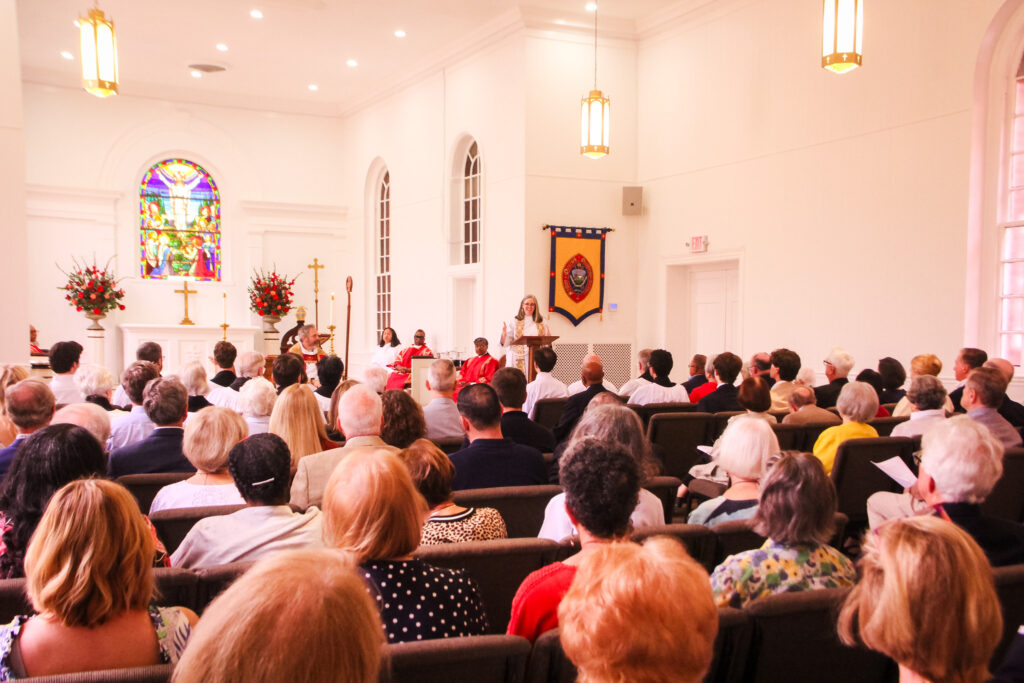
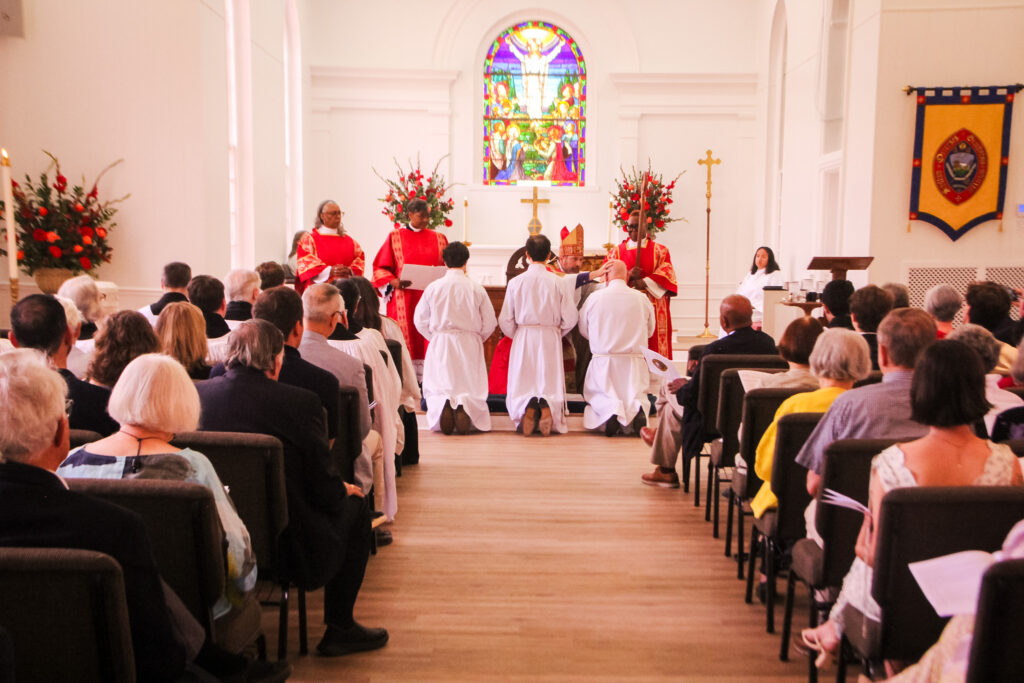
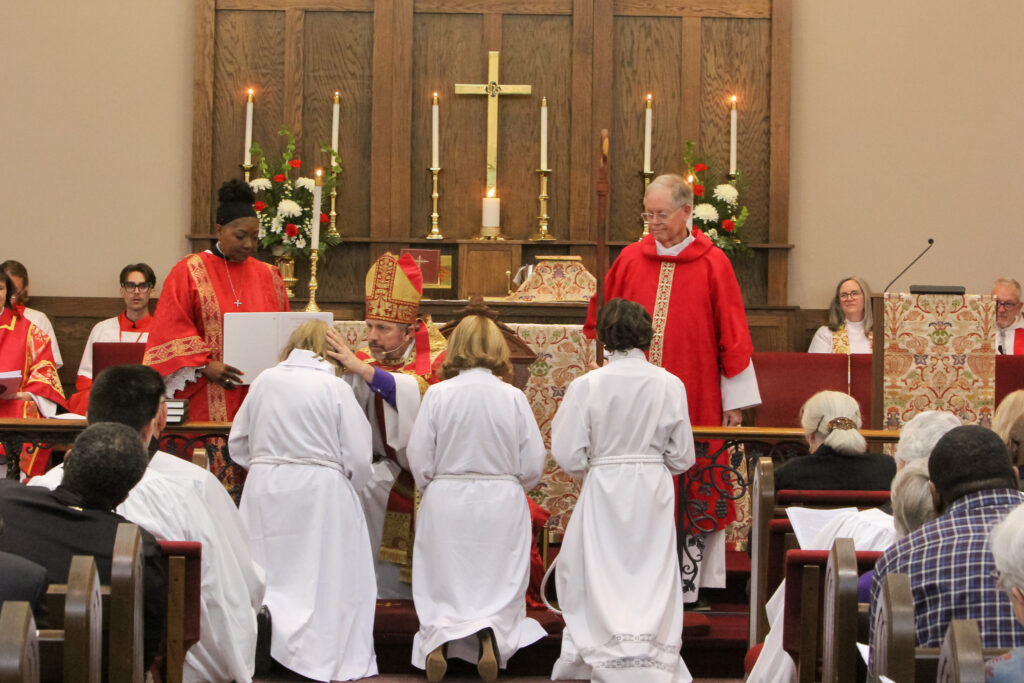 This is the outside-in message of the Kingdom of God that Jesus proclaimed to a world turned from God. Like the last being first and the humble being exalted, Jesus put the margins in the center. This is the ministry of a deacon. In the words of the Ordination Rite for a Deacon, “
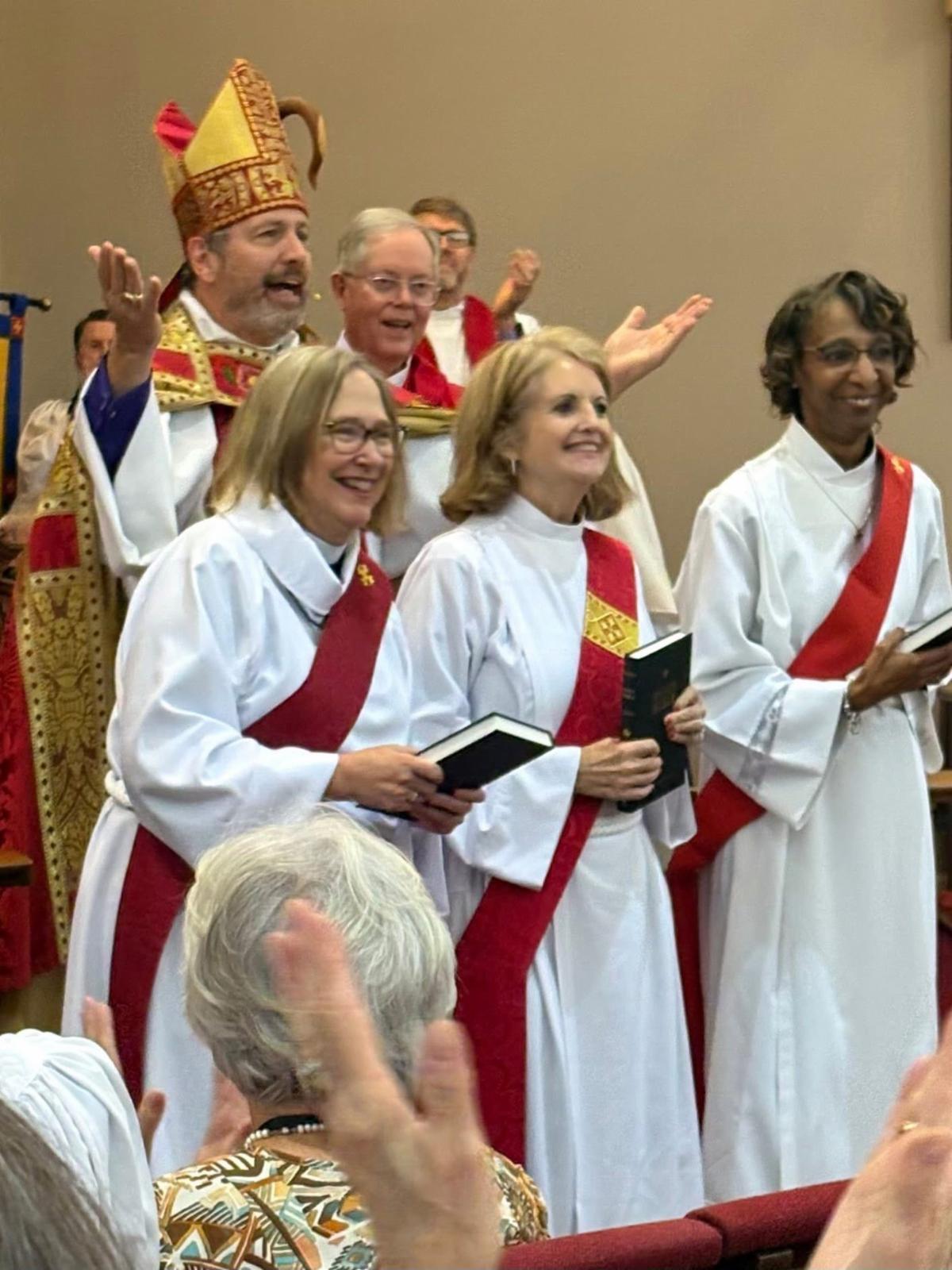 The Holy Spirit led each of these women to use their considerable gifts in service of others. This is, of course, what we are all to do as baptized Christians, to serve others as if we are serving Jesus and we are also to allow others to serve us. This mutual care best reflects the love of the Holy Trinity.
 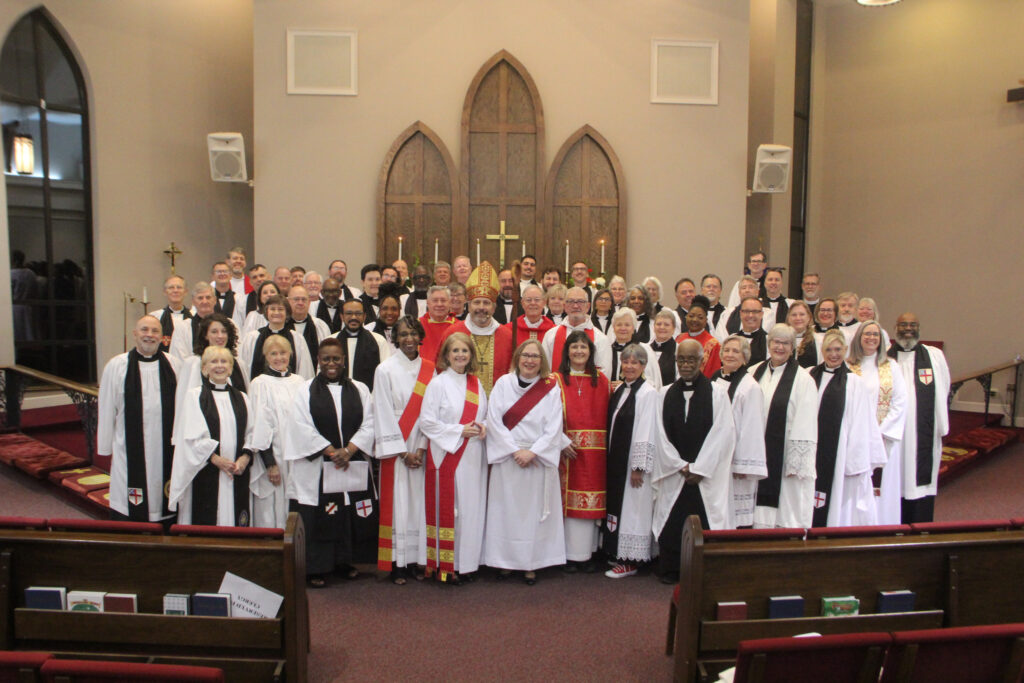 Deacons are icons of the servant ministry that embody this call. When deacons are doing their work of taking the church out into the community and bringing the needs of the community into the church, more of the congregation is challenged to join them or to find their own way to serve. This is how deacons encourage and strengthen the faithful into loving one another as Jesus loves us.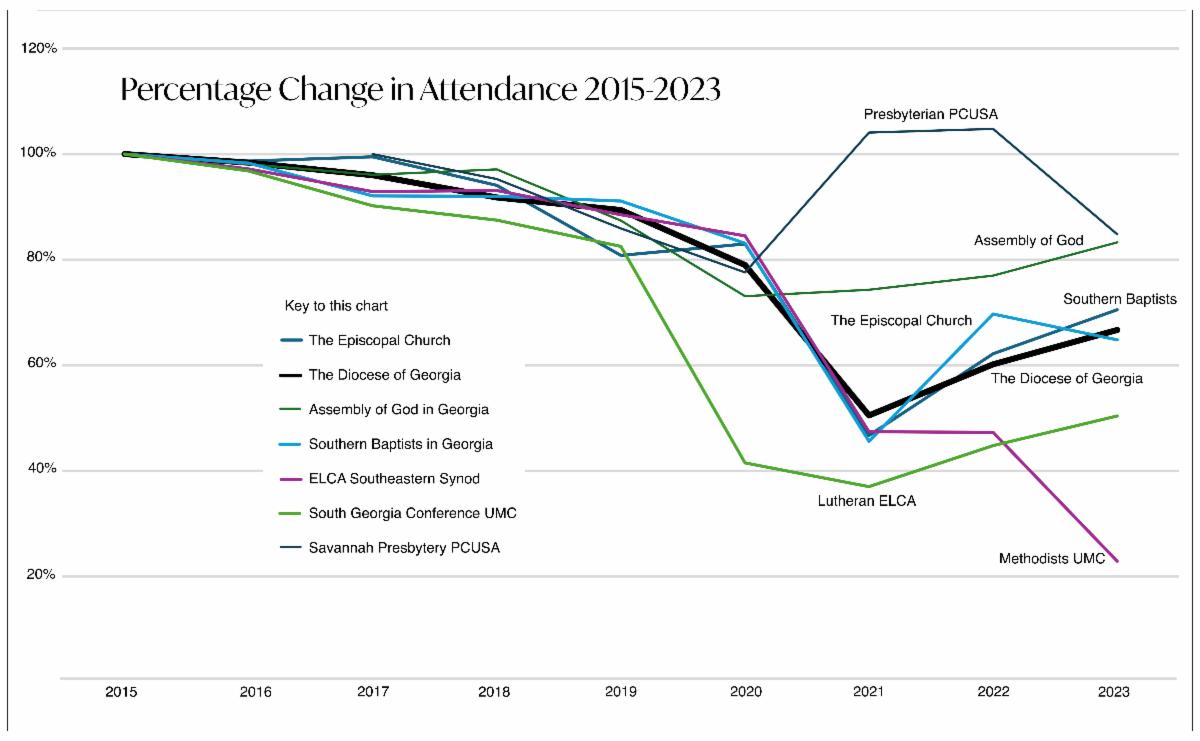
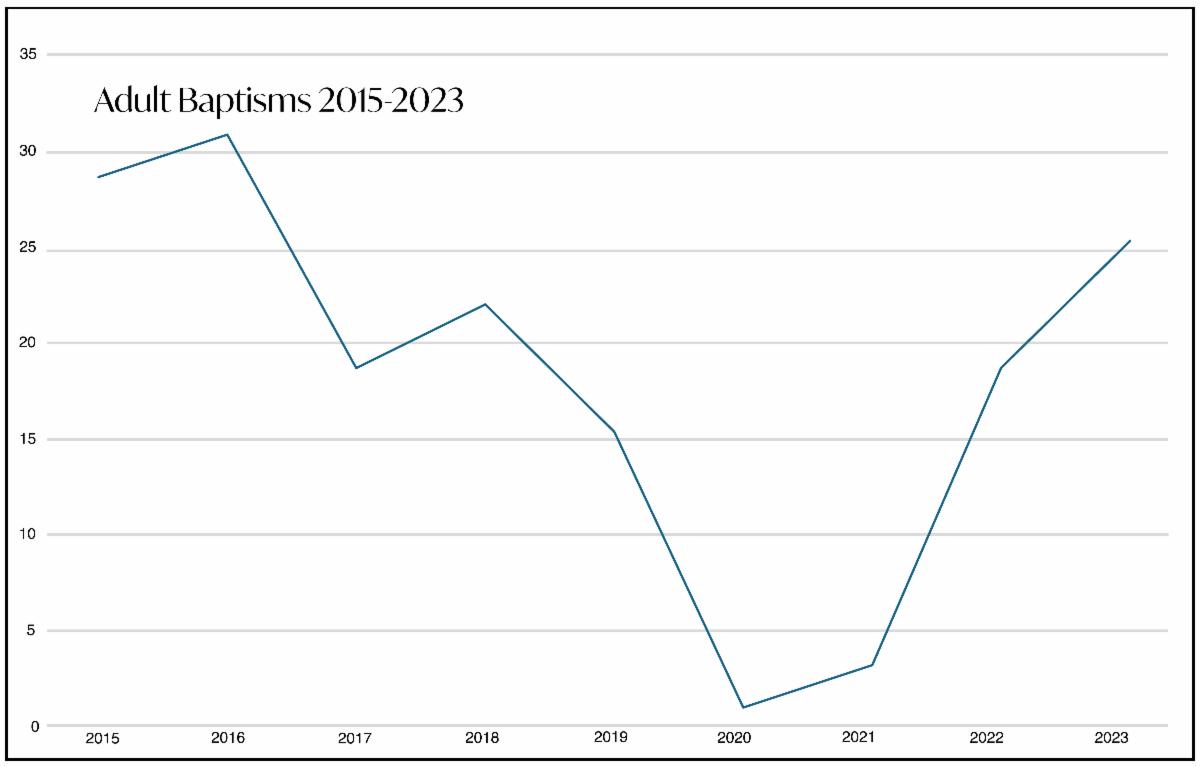 You will find charts of confirmations and receptions, alongside baptisms, and adult baptisms in the book as well. Even with declining attendance, we see those numbers bouncing back now in ways that fit what I am seeing in my travels. We have also seen Cursillo thriving once more with two weekends a year bearing the fruit we have come to expect from those retreats. Yes, attendance is not back to where we were and yes, the number of lives changed by the Gospel of Jesus Christ is more than we should expect given that decrease. God is not done with the Episcopal Diocese of Georgia. The Holy Spirit is working in and through us and sometimes in spite of us to touch the lives of people who need the grace, mercy, and forgiveness we have found.
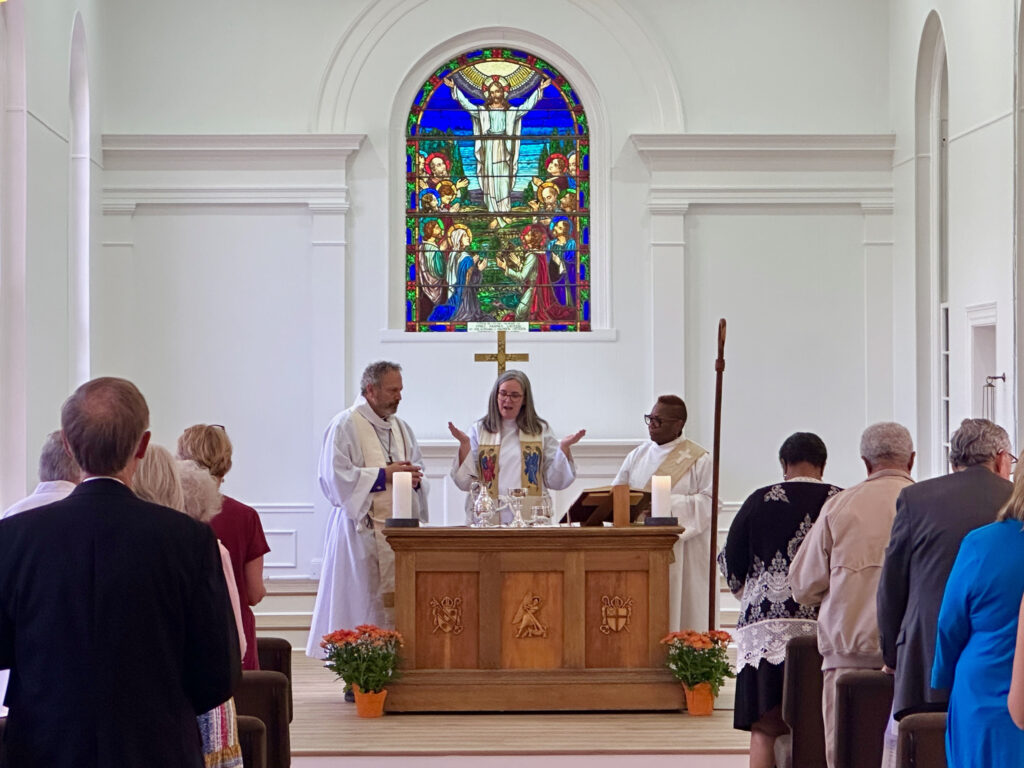 This consecration of space is an ancient practice. Our Old Testament lesson describes King Solomon consecrating the Temple in Jerusalem. Before that, Moses had consecrated the Tent of Meeting that served as the focal point of worship for the people of Israel. In each case, they offered sacrifices to God as they prayed for the ground and the tent and temple to be hallowed by the presence of the Spirit of God. This way of setting aside space for holy purpose has continued through the millennia.
 I hope that this dedication will also inspire us as a Diocese of Georgia to stand against the type of injustice that Deaconess Alexander faced through her entire ministry. Her years as a Deaconess from 1907 to her death in 1947 coincide exactly with the dates that our Diocese held segregated conventions with a separate, but not equal, meeting for black Episcopalians. Anna had to work hard to earn extra money, including through cooking meals for our summer camp that was on St. Simons Island in her day. While Camp Reese had an Anna Alexander Cabin it was described in a 1945 article in The Living Church as “a servants’ house built by the young people and named in honor of Deaconess Alexander.”